
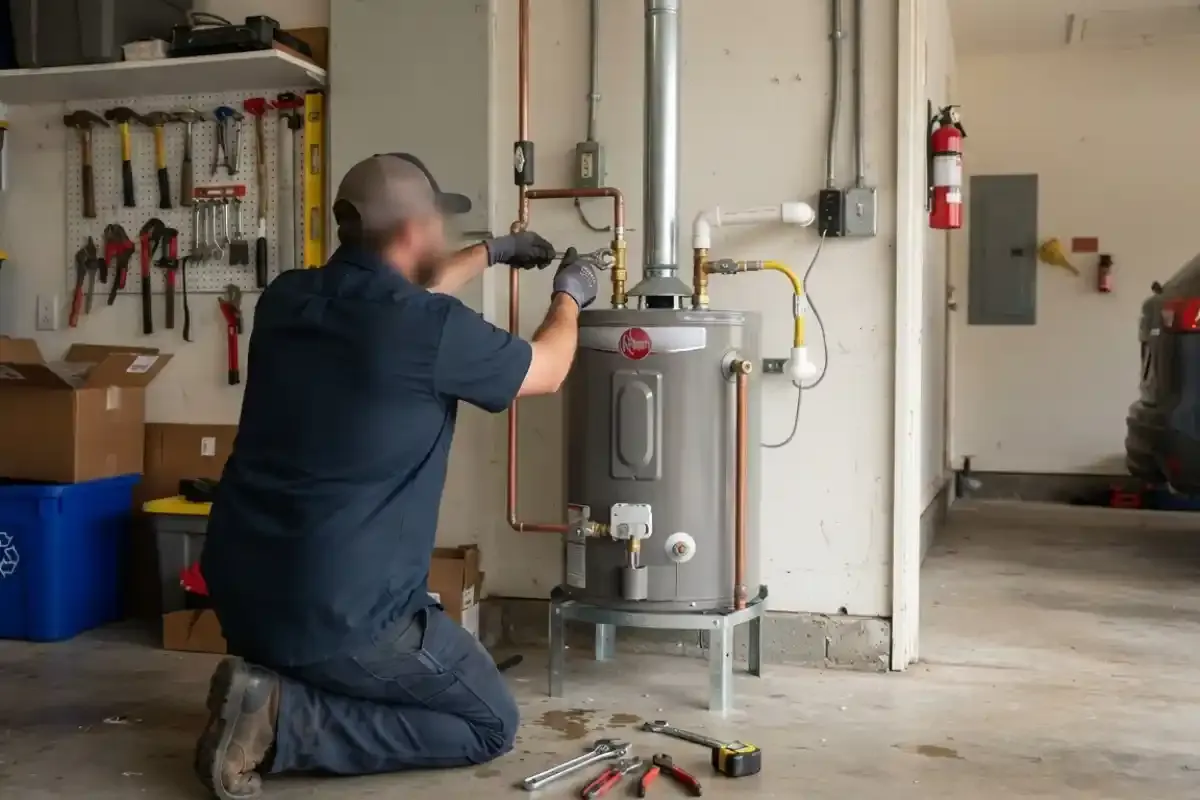
Planning an install while the old heater still works
The best time to replace a heater is before it fails. A tank that is old, noisy, rust-stained at the base or leaking at the fittings is a candidate. Waiting for the flood means the choice shrinks to what is available that day, and a wet closet becomes part of the repair.
A planned install lets you pick a size that matches how your household uses hot water, pull the permit in time, and have the area cleared. It also lets us look at the whole setup, including shutoff valves, venting, the gas line and the drain pan, before the old unit comes out.
If your tank is already leaking from the shell, it cannot wait for a planned appointment, and water heater replacement is the right page.
Gas line capacity is the hidden limit on a tankless upgrade
The City of Colton water heater permit page warns that a tankless unit can need up to five times the BTU input of a standard heater. A gas tank might use a modest burner. A tankless unit fires hard in short bursts to heat water as it flows, so the same line that fed the tank may be too small.
That means the gas pipe, the meter capacity and the run length all matter. The line may need upsizing, which adds time, permits and cost to the project. Ask for the gas load check before you buy the unit, not after it is on the garage floor.
Tank, tankless or hybrid: how the three types compare in a Colton home
No type wins for everyone. The right one depends on space, fuel and how you use hot water.
| Type | How it works | Best fit | Trade-off |
|---|---|---|---|
| Standard tank | Stores and keeps a fixed volume of hot water ready | Most houses with a good location already in place | Standby heat loss, limited hot water in long use |
| Tankless | Heats water as it flows, with no storage | Homes that need endless hot water and have wall space | Gas line may need upsizing, annual descaling in hard water |
| Hybrid (heat pump) | Moves heat from the surrounding air into a tank | Electric homes with open air space around the unit | Needs clearance, a condensate drain and electrical supply |
| Electric tank | Uses immersed elements to heat the stored water | Homes with no gas service | Higher running cost than a heat pump, element wear from scale |
Gas-to-electric conversion is not allowed under the City of Colton alteration path, so ask the Building Division before planning a fuel change.
Moving the heater: relocation, closets, garages and outdoor installs
Moving a heater is a bigger job than swapping one in place, and the city treats it that way. The City of Colton permit page says a change-out at the same location gets one final inspection. A new location gets a rough plumbing inspection plus a final one.
An outdoor install needs Planning approval first, before the permit moves ahead. If you have in mind a heater in a side yard enclosure, a garage corner or a new closet, raise it early. We can sketch the plan, and the Building Division confirms what it needs on the site plan.
Common reasons to relocate include a flood-prone closet, a heater too far from the kitchen and bathrooms, and a need to free space. Shorter hot water runs waste less water waiting for heat, so placement has a real practical payoff.
What to prepare before your installation day
Preparation shortens the visit and avoids a second trip.
- Clear a path. Move boxes, shelves and vehicles so we can carry the old tank out and the new one in without detours.
- Locate shutoffs. Find the main water valve and, for gas, the gas shutoff, and tell us if either sticks or leaks.
- Photograph the data plate. A picture of the old label shows the fuel type, size and model so we can match connections.
- Decide the type early. Tank, tankless or hybrid changes the parts, the permit paperwork and the schedule.
- Confirm who can approve. A renter needs the owner's approval. The permit is pulled by the owner or an insured California-licensed contractor.
- Plan for a short water outage. Water is off for part of the day. Fill what you need, and know that hot water returns after the new tank heats.
The permit steps for a water heater in Colton, one at a time
These steps follow the City of Colton water heater permit page. Confirm current details with the Building Division.
- Decide who pulls the permit. The owner can, or an insured California-licensed contractor. That means a C-36 plumbing contractor, or a B contractor under the multiple-trade rule.
- Prepare the paperwork. You need the permit application, identification and a signed CF1R-ALT-01-E energy form.
- Draw the site plan. The plan shows where the heater sits. For a new location, the plan and the rough plumbing details matter more.
- Get Planning approval for an outdoor install. The page says outdoor installs need Planning approval before the permit can proceed.
- Schedule the inspection. A same-location change-out gets a final. A new location gets rough plumbing and a final. The Building Division takes requests until 4 pm for the next day.
What determines the price of a planned water heater install
A planned install can be quoted more carefully than an emergency one because we can see the site first. The price still moves with a few real variables.
Bundling other plumbing installs into the same visit
A heater install often exposes other work worth doing while the water is off, such as replacing old shutoff valves, adding a new hose bib, or installing a pressure-reducing valve. Grouping jobs saves a second shutdown and a second trip.
If you are adding fixtures, a dishwasher line or a new bathroom feed alongside the heater, our plumbing installation service handles those, and we can quote them together. We will tell you if a task falls outside plumbing, such as new electrical circuits, which belong to a licensed electrician.
Colton's hard water and what it means for a new heater's first years
The City of Colton's Consumer Confidence Report shows total hardness for the Colton/Rialto supply averaging 206.67 mg/L, about 12 grains per gallon. That is in the very hard band of the USGS scale, which starts at 181 mg/L. Scale from water at that level coats elements and burner surfaces, and builds up in a tankless heat exchanger.
Plan a maintenance routine when you install, whether that is a tank flush schedule from the manufacturer or an annual descale on a tankless unit. A water softener on the supply is another option to discuss, and it affects warranty terms, so read the heater's manual.
Homeowners in Loma Linda and other nearby towns have different water systems, so do not assume their hardness matches Colton's. For your own address, test your tap and ask your water utility for its annual report.
Frequently asked questions
Per the City of Colton permit page, the owner can, or an insured California-licensed contractor. A C-36 plumbing contractor qualifies, and so does a B contractor under the multiple-trade rule. You can check a license on the CSLB website.
The application, identification, a signed CF1R-ALT-01-E energy form and a site plan. An outdoor install also needs Planning approval first. The Building Division can confirm the current list.
The city page says a change-out at the same location gets one final inspection. A new location gets rough plumbing plus a final. Inspections are scheduled with the Building Division.
Maybe not. The city permit page says tankless units can need up to five times the BTU input of a standard heater, so the gas line may need upsizing. We check pipe size, run length and load before recommending a unit. See tankless water heater service for more.
It depends on space, fuel and hot water use. Tanks are simple and common. Tankless saves floor space but may need gas upsizing and yearly descaling in hard water. Heat pump units need open air and an electric supply.
Often, with planning. A new location means a rough plumbing inspection plus a final. An outdoor install needs Planning approval from the city first. Raise the idea early so the site plan is right.
The city permit page says gas-to-electric conversion is not allowed under the alteration path. Ask the Building Division what applies to your home before buying equipment.