
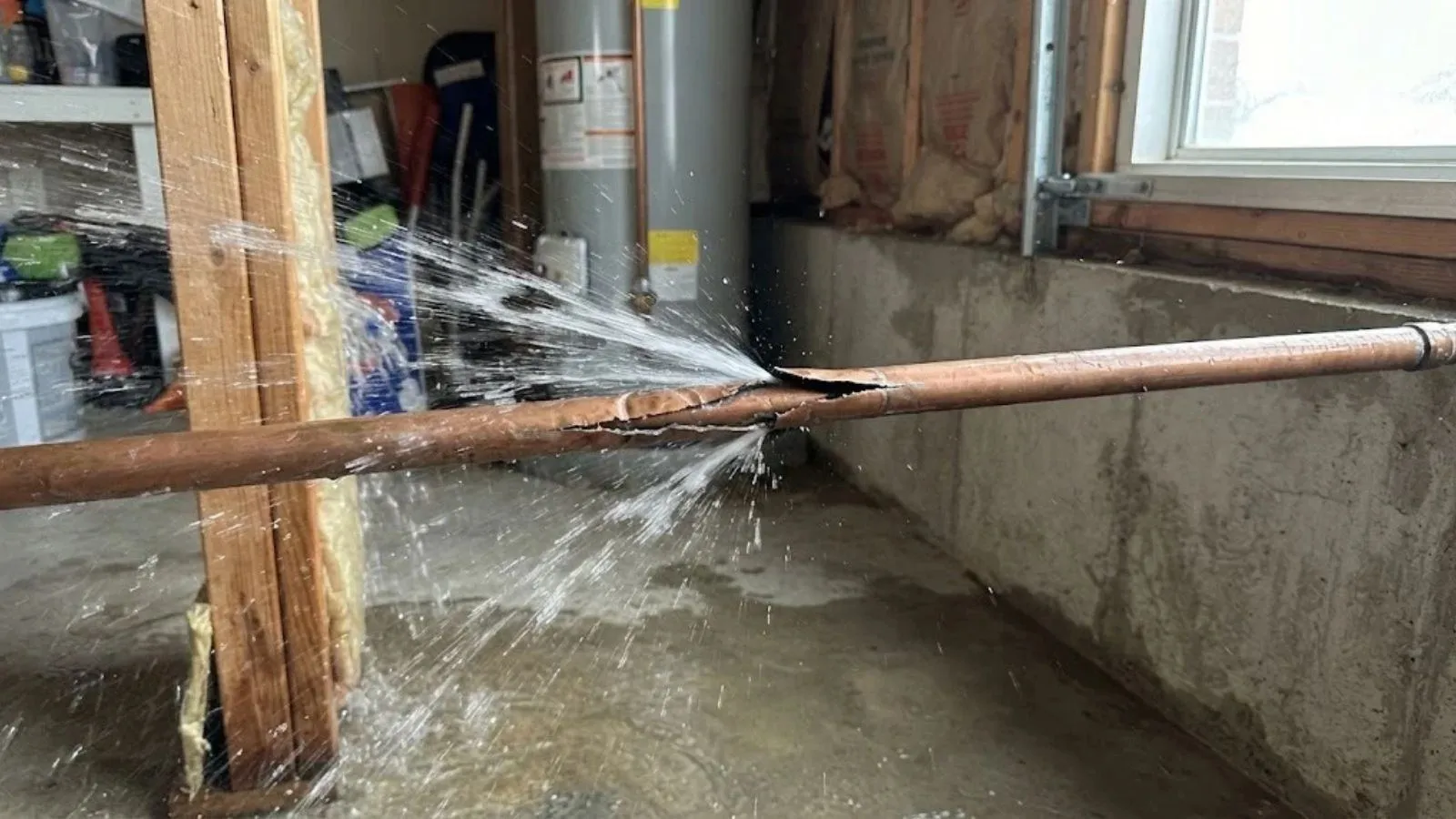
Cracked, split or pinholed: what each failure looks like
Different breaks need different responses, so it helps to describe what you see.
Spraying or gushing water
A split or blown fitting. Shut the main valve immediately, because every minute can add water to the structure.
Steady drip from a pipe or joint
A pinhole, a loose compression fitting or a worn solder joint. It looks small but can wet insulation and framing for weeks.
Water stain growing on a ceiling or wall
A pipe is leaking out of sight. Shut the water, then have the line located before the wall is opened.
No water at all, or a broken shutoff
A broken water valve, a failed supply line or a closed main can leave taps dry. A valve that snapped or will not turn needs repair or replacement.
Wet soil or a bubbling lawn
A break in the buried line. See water line repair for service line work.
Why pipes burst in a mild-winter city
Freezing is the cause most people expect, but frozen pipes are less likely in a mild-winter climate like Colton's. As general plumbing reasoning, a burst here more often traces to corrosion that thinned the wall, a joint that failed, or water pressure that was too high for the pipe. The pressure regulator, if there is one, is part of the picture.
Corrosion works slowly. A copper pipe can develop pinholes from the inside, and galvanized steel narrows and rusts from within. Joints fail where solder or a fitting was imperfect or where movement wore it over years. A sudden surge, such as a water hammer from a fast-closing valve, can then finish the job.
That matters for repair, because patching one burst without checking the rest invites the next failure. A technician looks at the cut ends, the nearby fittings and the pressure before closing up the wall.
Burst pipe right now: what to do first while the crew is on the way
A burst pipe is an emergency. Call the 24/7 line now, since dispatch is open at night and on weekends and same-day appointments are available when schedules allow. Then do the following in order.
- Close the main water valve. Turn it fully clockwise. It is often near the water heater, in the garage or on the outside wall facing the street.
- Mind the electricity. Water and power do not mix. If water is near outlets, a ceiling light or the panel, stay away and turn off power only if the breaker is dry and reachable.
- Drain the lines. With the main closed, open a faucet at the lowest point and one at the highest. This releases pressure and drains the pipes so less water escapes.
- Turn off the water heater. If the water supply is cut, an electric heater can overheat when the tank empties. Switch off the breaker or set a gas heater to pilot.
- Stop the damage and record it. Move belongings, scoop standing water if safe and photograph or film all wet areas before cleanup.
Copper, PEX and drain pipe: how each kind is repaired
Copper pipe repair often means cutting out the damaged section and soldering or pressing in a new piece with proper fittings. If corrosion has thinned the pipe over a long stretch, replacing the full run is more durable than patching a single hole. Mixed metals, such as copper joined to steel without a dielectric fitting, can corrode at the connection, which a technician checks.
PEX and plastic supply lines are repaired with crimp, clamp or push fittings sized to the pipe. These materials resist some corrosion, but a failed fitting, a kinked bend or sun exposure can still cause a leak. The fix is usually fast once the leak is exposed.
Drain pipe repair differs because drain pipes are not under pressure. A cracked drain leaks only when water runs through it, so the signs are damp spots after showers or a soggy floor near a fixture. A cracked drain can be repaired by replacing the broken section. For problems farther out in the yard, see sewer line repair.
Match the break to the repair: a quick reference
This table shows the usual repair path, though a technician decides on site.
| What failed | Typical cause | Usual repair |
|---|---|---|
| Pinhole in copper | Internal corrosion | Replace the section, and check the rest of the run |
| Split in copper or PEX | Pressure surge, wear or impact | Cut out and replace the damaged length |
| Failed joint or fitting | Old solder, loose connection | Remake the joint or replace the fitting |
| Broken shutoff valve | Seized or worn valve | Replace the valve |
| Cracked drain pipe | Age, impact or settling | Replace the cracked section |
Several pinholes along one pipe usually mean the whole run is wearing out.
Moisture and damage records to gather after a burst
Good records help your insurance claim and make drying faster.
- Photos and video. Capture the break, the wet walls, the flooring and the water on the meter before anything is moved.
- Meter reading. Write down the reading at shutoff so any water loss can be tied to a date and time.
- Dry quickly. Remove standing water, run fans and a dehumidifier, and lift wet carpet. Damp materials can grow mold in a couple of days.
- Save what you remove. Keep a section of the failed pipe. It shows the cause and may help the claim.
- Call your insurer early. Report the loss, ask what they cover and ask whether they want to inspect before cleanup.
What shapes the price of a burst pipe repair
A burst pipe repair can be small or large depending on what is damaged and how hard it is to reach. We explain the job and the cost before work begins.
Colton water chemistry and pipe age: what they mean for a burst
The City of Colton's 2024 water quality report shows average hardness near 207 mg/L, about 12 grains per gallon. Hard water leaves scale on the inside of pipes and on the hot side of a water heater, which can reduce flow and add stress to fittings. We cut open a failed section to see whether scale or corrosion contributed.
About 52 percent of Colton homes were built before 1980, so many have older plumbing. That does not mean a burst is coming, but it does mean the condition of nearby pipe is worth a look when one section fails. If the whole system is wearing out, our repiping page explains the larger option.
We also help homeowners in San Bernardino and nearby towns. Repairs and replacements on a supply line fall under the California Plumbing Code, which is based on the Uniform Plumbing Code (UPC), so the pipe, fittings and joints used must be ones the code accepts.
Frequently asked questions
Yes. The 24/7 line takes burst pipe calls at night and on weekends across Colton. Same-day appointments are available when schedules allow. Shut the main water valve and call.
Close the main water valve, keep clear of wet electrical areas, and open a low faucet to drain the lines. Then call for a plumber. Take photos of the damage before cleanup.
As general plumbing reasoning, corrosion, a failed joint or high water pressure are more likely causes than freezing in a mild climate. The cut pipe usually shows which one it was.
Often yes. A single failure can be cut out and replaced. If the pipe has several pinholes or heavy corrosion, replacing a longer run lasts longer than repeated patches.
Check whether the main valve is open and whether neighbors have water. If your valve is stuck or snapped, or you hear water running inside, a plumber should check it. The City of Colton Water Utilities Department can tell you about any outage.
It can be, depending on the flow. A small spray is urgent because it soaks framing and insulation. Close the valve to that branch if you can and call.
Burst pipe repair fixes a pipe that has visibly failed. Leak detection finds a hidden leak first. See our leak detection page if you cannot see where the water is coming from.