
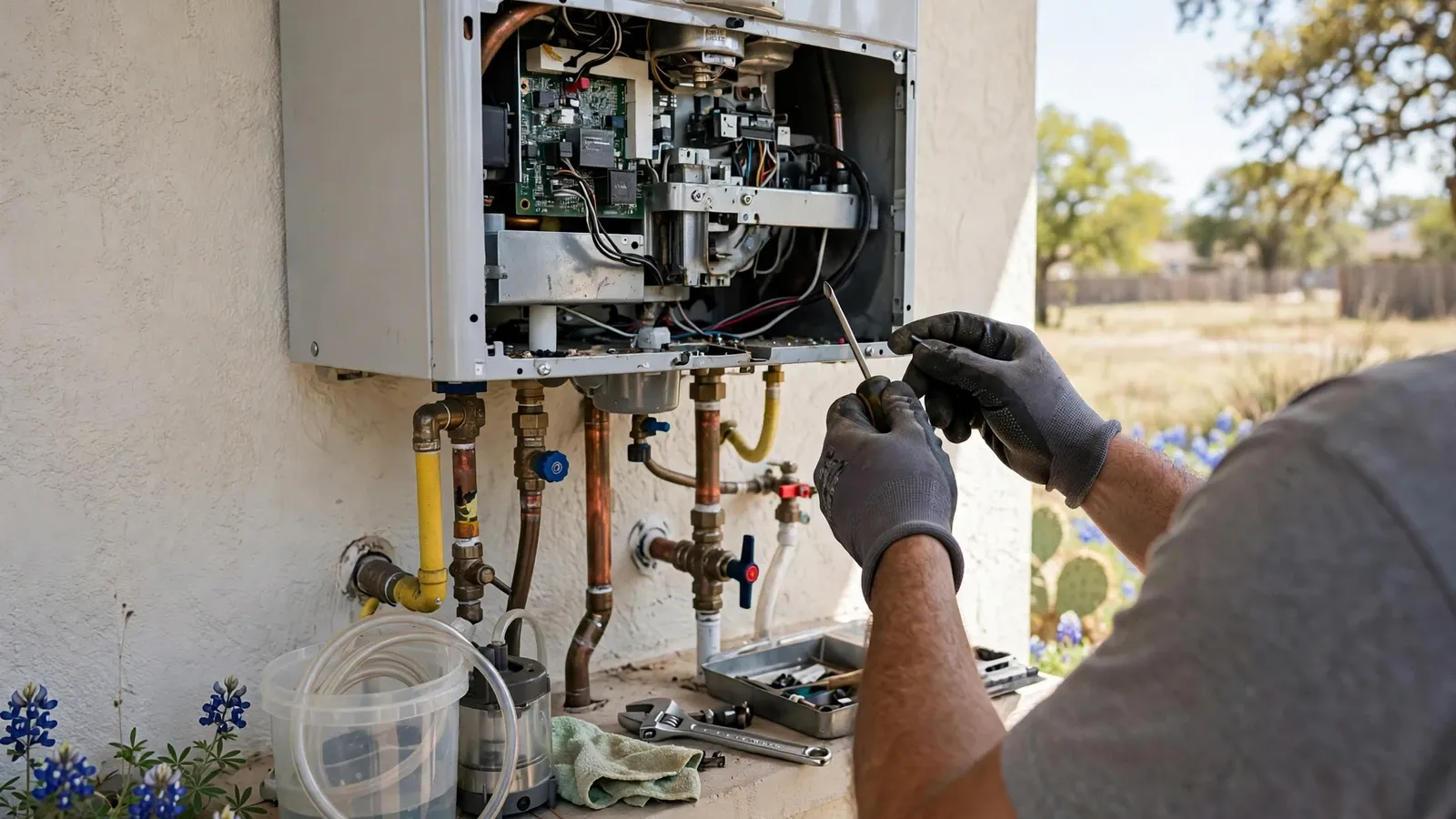
Why a tankless flush matters at Colton's water hardness
A tankless flush, also called descaling, circulates a descaling solution through the heat exchanger using a small pump and the unit's service ports. The solution dissolves the calcium and magnesium scale that hard water leaves on the narrow water passages. We then rinse the unit and clean the inlet screen.
The City of Colton's water quality report lists the Colton/Rialto supply at an average of 206.67 mg/L total hardness, roughly 12 grains per gallon. That is in the very hard band of the USGS scale, which starts at 181 mg/L. A tankless heat exchanger has thin channels, so even a thin layer of scale restricts flow and insulates the metal from the water.
Once scale insulates the exchanger, the burner has to work harder to reach the set temperature, and sensors can trip on overheating. How often to flush is manufacturer guidance and depends on your model and water. Read your manual for the interval and the approved solution, because using the wrong one can harm the unit.
What to have ready before a tankless service visit
The details below let us bring the right parts and procedure.
- Model and serial number. The data plate shows the model, the manufacture date and the fuel type, which decide the manual we follow.
- The error code on the display. Write down the exact code and when it appears. Do not clear it before we arrive if you can avoid it.
- Service history. When the unit was last flushed, if ever. Many units in hard water have gone years without it.
- Isolation valves. If your install has service valves on the water lines, tell us. If not, adding them is part of a proper flush setup.
- Symptoms by fixture. Does it fail at one tap, all taps, or only when two run together? That narrows the cause quickly.
- Access to the unit. Clear the wall space, and tell us about any outdoor enclosure or locked gate.
Reading tankless symptoms: what each one usually points to
These pairings come from how the units are built, not from a single diagnosis. A technician confirms the cause.
| Symptom | Likely cause | What we check |
|---|---|---|
| Error code on the display | Scale, a sensor fault, a blocked vent or low gas pressure | The code in the manual, then the matching component |
| Hot, then lukewarm, then cold | Scale restricting flow, flame cutting out, or the minimum flow not met | Inlet screen, heat exchanger, flow sensor and gas supply |
| Cold burst between two hot uses | Cooled water in the pipes arriving after a short pause (normal), or a recirculation fault | Pipe run length, recirculation setup and sensor behavior |
| Weak flow only on hot | Clogged inlet screen or scaled exchanger | Screen, filter and exchanger flow rate |
| Unit does not fire when a tap opens | Flow below the start threshold, igniter or flame sensor fault | Flow rate, igniter, flame rod and power |
Gas smell means leave the building and call the gas utility or 911 first, then call us.
Lukewarm, then cold: the pattern that sends owners looking for a new unit
The classic tankless complaint starts with a good first minute of hot water and then a slow slide to lukewarm and cold. Several things cause it. A scaled heat exchanger cuts flow and overheats the sensor, so the unit shuts down. A clogged inlet screen starves the unit. Low gas pressure or a partly blocked vent makes the flame cut out.
Another cause is the so-called cold water sandwich. When you stop a shower and start it again, the water in the pipes has cooled while the unit shut off. A cool slug arrives before hot water returns. That pattern is normal behavior, and a recirculation setup or a small buffer tank can reduce it.
If your unit shows an error code, write it down before you reset it. A code tells us which sensor tripped, and a repeated reset only hides it. If the unit needs service after years without it, that is common, and a flush is often the first fix.
What decides the cost of tankless service, repair or install
A flush is a defined job, while a repair or install depends on what we find. These factors explain the range.
Sizing and installation checks before you buy a tankless unit
Most tankless disappointments trace back to sizing and site, not the unit itself.
- Peak hot water demand. Add up the flow of the fixtures you run at the same time, such as two showers and a kitchen tap, and pick a unit that covers it.
- Temperature rise. The unit has to heat cold incoming water to your set temperature. A bigger rise needs more capacity.
- Gas line capacity. A tankless unit needs far more gas than a tank. The pipe size, meter and run length must support it.
- Venting path. The unit needs a vent route and clearance as set by the manufacturer. Ask the Building Division about code requirements.
- Water quality plan. In very hard water, plan for annual descaling, service valves, and possibly a softener.
- Placement. The wall space, an outdoor enclosure and the distance to the fixtures all matter.
Colton's gas line rule and hard water, both settled before the unit arrives
The City of Colton water heater permit page notes that a tankless unit can need up to five times the BTU input of a standard heater, so the gas line may need upsizing. Plan for that before you order a unit, because a larger pipe adds work and a permit conversation.
The same city page says gas-to-electric conversion is not allowed under the alteration path. If you are thinking about leaving gas, ask the Building Division what applies to your property first. The page does not state rules about venting, so we point you to the Building Division for those.
The City of Colton's report puts total hardness for the Colton/Rialto supply at 150 to 230 mg/L, so scale is a standing issue. A water softener can reduce scale on the heat exchanger, though your manual may say how it treats the warranty.
Service it or replace it: an honest look at a tired tankless unit
A tankless unit that has gone years without a flush can often be brought back. If the exchanger is only scaled, a flush restores flow and the unit works normally. If the exchanger has cracked from repeated overheating, or the board has failed, repair may cost close to a new unit.
We will tell you which side your unit falls on, with a written price for each option. For other water heater work, see water heater repair for tank units. Our service area includes Grand Terrace as well as Colton.
We do not do electrical panel work. If a tankless unit needs a new circuit, a licensed electrician handles that part.
Frequently asked questions
We connect a pump and hoses to the service ports, circulate descaling solution through the heat exchanger, then rinse and clean the inlet screen. The time depends on how much scale is in the unit. Follow your manual for the approved solution and the interval.
Follow the manufacturer guidance for your model, which is usually tied to water hardness. Colton's reported average of about 207 mg/L is very hard on the USGS scale, so many owners flush more often than the manual's minimum. We can set a schedule.
Write the exact code down and check the manual. Many codes involve scale, flow or ignition. Reset it once, but if it comes back, call us with the model number so we can follow the right procedure.
Common causes are scale restricting flow, a clogged inlet screen, low gas pressure and a blocked vent. A short cold burst after a pause is a different, normal pattern called the cold water sandwich.
Usually not. Scaled exchangers often recover with a flush. If a cracked exchanger or a failed board turns up, we will say so and give you a written price for repair and for replacement.
Not always. The City of Colton permit page says tankless units can need up to five times the BTU input of a standard heater, so the line may need upsizing. We check pipe size and load before you commit.
A softener lowers scale on the heat exchanger, but a flush is still recommended by most manufacturers. Check your warranty terms and ask us about sizing.