
White crust, spotted glasses and burned-out elements: what very hard water leaves behind
Hardness is dissolved calcium and magnesium. When hard water dries on a faucet or a glass, the water leaves and the minerals stay, which is the white crust and the spots you wipe off. When hard water is heated, the minerals come out of solution and plate onto the hottest surface they touch.
Inside a water heater, that surface is the heating element or the bottom of the tank above a burner. Scale insulates it, so the element runs hotter, wears faster and fails early. That is the usual story behind a short-lived element in a hard water area.
Scale also builds up inside pipes, shower heads, dishwasher spray arms and tankless heat exchangers. It slowly narrows them and cuts flow. A softener removes the minerals before they reach any of it.
How to size and choose a softener for your home
A softener sized for the household regenerates less often and lasts longer.
- Test your water. A test strip or lab test of your tap gives your hardness. The city's report gives a supply-wide average, and your tap may differ.
- Count daily use. People in the home and daily gallons decide how many grains of hardness the unit removes between regenerations.
- Pick the capacity. A larger unit regenerates less often. An undersized one regenerates constantly and wastes salt and water.
- Choose the valve control. Meter-based valves regenerate by actual use. Timer valves run on a schedule whether or not it is needed.
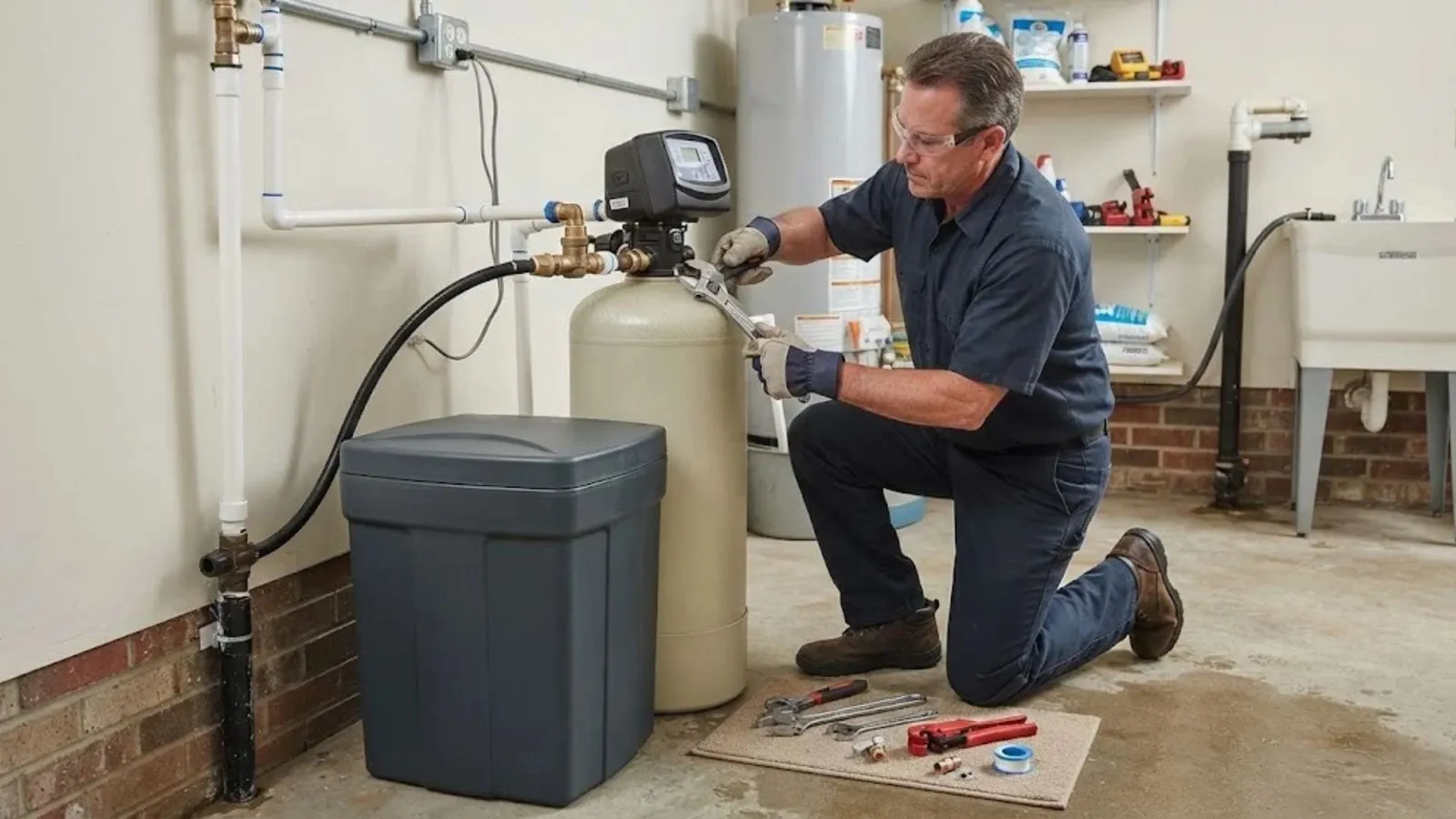
- Plan the location. The unit needs a drain nearby, an electrical outlet, a place for the salt tank and a bypass for outdoor lines.
- Ask about local rules. Ask the City of Colton Water Utilities and the Building Division whether any rules affect softener discharge or installation.
A softener is not a filter: two different jobs
A salt-based softener uses ion exchange. Resin beads hold sodium or potassium, and as hard water passes, the beads trade those ions for calcium and magnesium. When the resin is full, the unit regenerates with brine and flushes the minerals to the drain.
A softener does not remove chlorine, bacteria, or most chemicals. A carbon filter reduces chlorine taste and odor and some organic compounds. Reverse osmosis forces water through a membrane and removes many dissolved solids, but it wastes some water and is usually installed at one tap, not the whole house.
What a filter removes depends on its rating, so check the product's certification for the contaminant you care about. For health questions about water, ask your physician. We do not diagnose health effects of water.
Salt softener, salt-free conditioner, carbon filter and RO compared
Each system answers a different question, so the right choice depends on the problem you want to solve.
| System | What it does | What it does not do |
|---|---|---|
| Salt-based softener | Removes hardness minerals, so scale and spotting drop sharply | Does not remove chlorine, taste or most chemicals |
| Salt-free conditioner | Changes how minerals form crystals, so scale clings less | Does not remove hardness, and results vary with conditions |
| Whole-home carbon filter | Reduces chlorine taste and odor and some organic compounds | Does not soften water or stop scale |
| Reverse osmosis at one tap | Removes many dissolved solids for drinking and cooking water | Does not treat the whole home and produces wastewater |
| Softener plus carbon filter | Handles scale and taste together | Needs two sets of maintenance |
A softener adds a small amount of sodium to the water. If you are on a sodium-restricted diet, ask your physician.
What the City of Colton's water report says about hardness and treatment
The City of Colton's Consumer Confidence Report lists total hardness for the Colton/Rialto supply at a minimum of 150 mg/L, a maximum of 230 mg/L and an average of 206.67 mg/L. Divide by 17.1 and that is about 8.8 to 13.5 grains per gallon, with an average near 12. The USGS scale calls 181 mg/L and above very hard, so the average falls in that top band. Your own tap may differ, so test it.
The same report shows perchlorate at a maximum of 4.6 ug/L against a state limit of 6, and it says the city completed two treatment systems for three affected wells. Nitrate averaged 4.35 mg/L against a limit of 10. These are below the limits listed, and they are not what a softener targets. A softener is for hardness, not for contaminants.
For the full report, contact the City of Colton Water Utilities Department at 160 S. 10th Street. Ask which supply serves your address. Softener drain lines and bypass plumbing fall under the California Plumbing Code, which is based on the Uniform Plumbing Code (UPC), and the local standards for brine discharge are a question for the City water utility.
What drives the cost of a softener or filtration system
Treatment systems vary a lot in price, and the biggest swing comes from what you choose to treat and where the unit goes.
Drain, salt and upkeep: the maintenance a softener asks of you
Softeners are low drama when the basics are handled.
- Discharge to a proper drain. The regeneration water goes to a drain through an air gap, which keeps wastewater from siphoning back. Ask which California Plumbing Code edition applies.
- Keep the brine tank stocked. Check the salt level monthly and break up any salt bridge, a hard crust that stops brine from forming.
- Clean the brine tank. Sludge at the bottom can foul the resin and valve, so clean it when the tank is low.
- Watch for hardness breakthrough. If spots return, test the water. A failing resin bed or valve lets hardness pass.
- Keep a bypass for outdoor use. Garden lines and irrigation do not need softened water, and the salt load is not good for plants.
- Service the resin. Resin lasts for years but is not permanent. Chlorine and iron shorten its life.
Soft water for the water heater only: a partial option and its limit
Some homeowners treat only the water going to the water heater, since heat is what turns hardness into scale. That protects the heater and the hot-side pipes. It leaves the cold taps, the toilets and the dishwasher cold feed hard, so spotting on glass and crust on faucets continue.
If you choose this route, the plumbing needs a branch for the heater and a bypass for the rest. Whole-home softening is the more common route. Check your heater's warranty terms, because manufacturers differ on softened water. See water heater repair for what scale does to a tank and tankless water heater service for descaling.
Softener not softening: valve, resin and control problems we repair
When a softener stops working, the usual suspects are a salt bridge, a clogged injector, a worn valve seal, a failed control board, a stuck motor, or resin that has worn out. Soft water that suddenly runs hard is the sign. A test kit confirms it.
We repair softener valves and controls, replace valves when a repair is not worth it, and replace resin when the beads are spent. Water conditioner repair covers the same ground for salt-free units, where the media or a cartridge needs changing. If we think a unit is beyond saving, we say so.
We serve homes in Colton and nearby towns, including Rialto. Hardness differs by water system, so test the tap at your own address. We do not test or advise on health effects of water.
Frequently asked questions
Hard water leaves calcium and magnesium behind as it dries. Colton's reported average is about 207 mg/L, which falls in the very hard band on the USGS scale. A softener removes the minerals that form the crust.
Spots are dried minerals. A softener reduces them sharply, and a rinse aid in the dishwasher helps. Spots are cosmetic and do not indicate a contaminant.
Often, yes. Scale coats the element and insulates it, so the element runs hotter than designed and fails early. Treating the water or flushing the tank slows this.
No. A softener removes hardness minerals through ion exchange. A filter removes other things depending on its type, such as chlorine taste or certain chemicals. Many homes use both.
It depends on the goal. A salt-free conditioner changes how scale forms but does not remove hardness. A salt-based softener removes it. Salt-free uses no brine and no drain connection.
The city's report shows perchlorate and nitrate below the limits listed, and the city has treatment systems in place for affected wells. For personal health questions, ask your physician. Read the report from the City of Colton Water Utilities for details.
It drains to a household drain through an air gap, not onto the ground. Ask the City of Colton about any rules on discharge before choosing a location.