
Why Colton's very hard water keeps killing heating elements
The City of Colton's own water quality report lists total hardness for the Colton/Rialto supply at 150 to 230 mg/L, with an average of 206.67 mg/L. Divide by 17.1 and that is roughly 12 grains per gallon. On the USGS scale, anything above 180 mg/L counts as very hard, so the average sits in the top band.
Hard water leaves calcium and magnesium scale on whatever is hottest. In an electric heater, scale coats the heating element and acts like a blanket. The element can no longer shed heat into the water, so it runs hotter than it was built to and burns out early. In a gas tank, scale and sediment pile up on the bottom, between the burner flame and the water, which slows heating and makes the steel run hot.
That is why a repeat element failure or a heater that rumbles and pops is often a scale problem, not bad luck. Replacing a part without addressing the scale can mean the same call a second time. Ask the technician to show you the old element or the drained sediment.
Where a leaking water heater is actually leaking from
Water on the floor near a heater does not always mean the tank has failed. The source decides whether this is a small repair or a replacement.
The tank body
Water weeping from the steel shell or the bottom seam means the inner tank has corroded through. Nothing sold as a repair fixes a hole in the tank, so this one leads to replacement.
Inlet and outlet fittings
Drips at the top connections come from worn flex connectors, dielectric nipples or loose unions. These are real repairs, and the water often runs down the tank and looks like a body leak.
The relief valve and its pipe
A temperature and pressure relief valve opens when heat or pressure runs too high. A steady drip from the discharge pipe can mean a worn valve, high house pressure, or a tank that has nowhere for expanding water to go.
The drain valve
Plastic drain valves crack and brass ones seep at the threads, especially after a tank has been drained and the valve has been worked loose. A new valve is a quick fix when this is the only source.
Condensation
Cold water filling a tank can sweat on the shell, and some high-efficiency and heat pump units produce condensate by design. Dry the area and watch it. A puddle that returns only after hot showers is usually not a leak.
Garage and closet installs
A heater in a closet or garage can leak for days before anyone sees it, because the water soaks drywall, a wood sill or the slab edge. A drain pan with a line outside is the early warning, so check whether yours has one.
No hot water: the checks that separate a quick repair from a dead heater
A cold shower is the most common reason people call us urgently about a heater. The first split is fuel. On an electric unit, the usual culprits are a tripped breaker, a tripped high-limit reset on the thermostat, a failed upper element, or a failed thermostat. A dead lower element alone gives you a short supply of hot water that runs out quickly.
On a gas unit, we look at whether the pilot or igniter is working, whether the thermocouple or flame sensor is sensing flame, whether the gas control valve is opening, and whether the flue is drawing. If you smell gas at any point, leave the building and call the gas utility or 911 before you call us.
We test heater components and thermostats. Panel and house wiring problems belong to a licensed electrician, and we will tell you plainly when a no-heat call turns out to be one of those.
What a repair visit checks, in order
A diagnosis that skips steps tends to replace the wrong part.
- Find the source of the water or the cold. We dry the heater, run a paper towel along every joint, and trace drips upward to the highest wet point before touching anything.
- Read the data plate. The plate shows fuel type, capacity, model and serial number. The serial number tells us the age, and the model decides which parts exist.
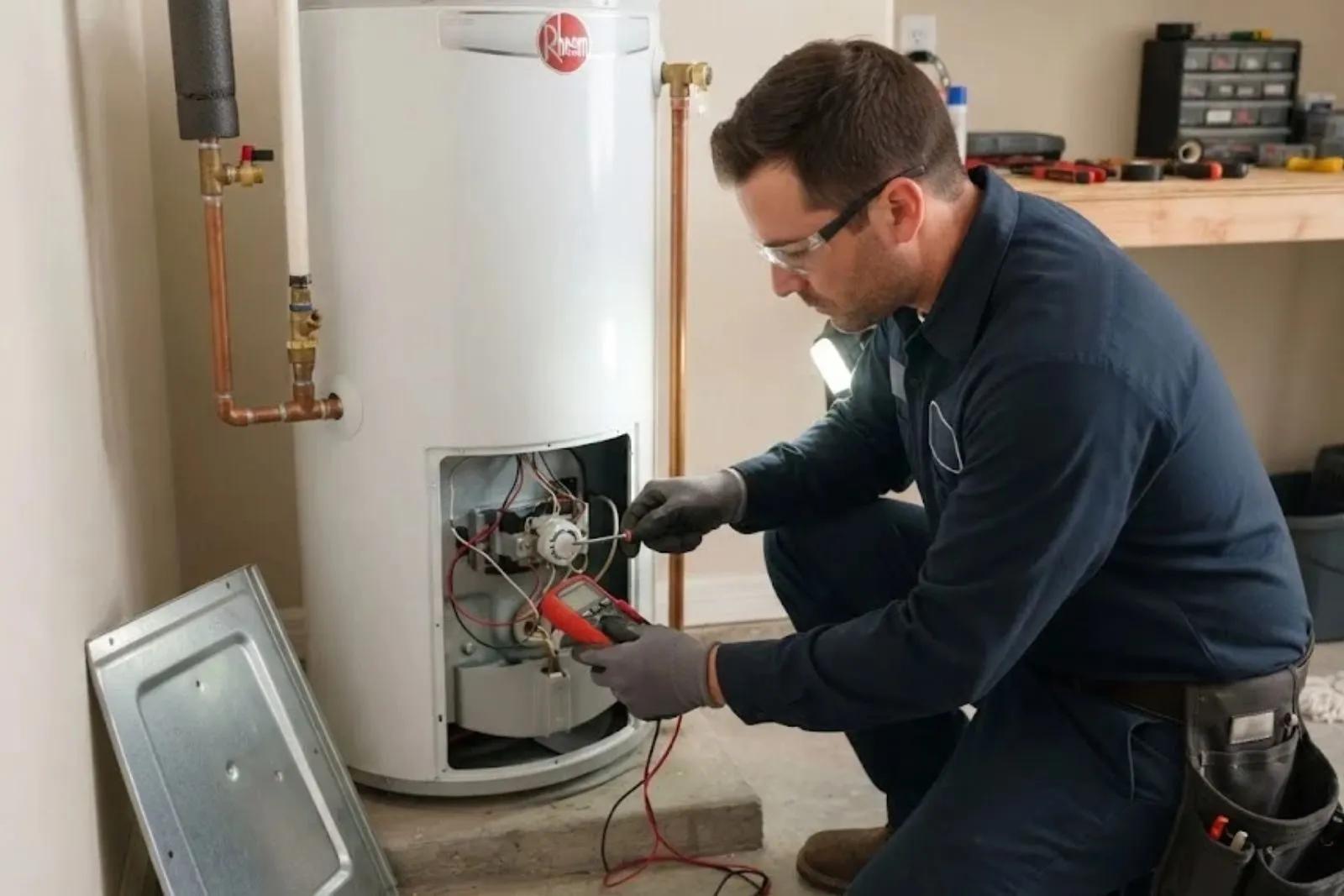
- Test the controls. For electric units we check power at the thermostats and resistance across each element. For gas units we check ignition, flame sensing, gas supply and venting.
- Check pressure and the expansion path. A gauge on a hose bib shows house pressure. High pressure or a closed system with no room for expansion can stress valves and fittings and cause repeat leaks.
- Look inside when it matters. If the tank rumbles or heats slowly, we drain a few gallons to see sediment and scale. What comes out tells us whether a flush is worth doing or the tank is past it.
- Give you the options with a price. You hear what failed, what a repair costs, and whether replacement makes better sense. The written price comes before work starts.
Repair or replace: how the decision usually falls
These are the findings that most often tip the decision, based on how tanks wear.
| What we find | Usually | Why |
|---|---|---|
| Leak from the tank shell or bottom seam | Replace | The inner steel has corroded through and cannot be sealed. |
| Leak at a connector, drain valve or relief valve | Repair | These parts are replaceable and the tank itself is intact. |
| Failed element or thermostat on a younger tank | Repair | A part swap restores heat if the tank is sound and scale is manageable. |
| Failed element on an old tank with heavy scale | Depends | Another part may fail soon. Compare repair cost with replacement honestly. |
| Rusty hot water and a rotted anode rod | Depends | A new anode may help if the tank lining is still sound. A rust-colored tank base says otherwise. |
Your heater's age matters, but condition matters more. A data plate and an inspection settle it better than a calendar.
What decides the price of a water heater repair
Water heater repairs range from a single replaceable part to a job that is really a tank swap in disguise. The factors below explain why two similar calls can end up at different prices. If a leak has already soaked a wall or floor, leak detection can confirm whether the heater is the only source.
Gas, electric and heat pump heaters fail in different places
Gas tank heaters fail at the burner assembly, the igniter or thermocouple, the gas valve and the flue. Their repair cost depends on whether a gas component or a simple sensor failed. Electric tanks fail at elements and thermostats, which are inexpensive parts, so an electric repair is usually the more repairable of the two.
Hybrid or heat pump water heaters add a compressor, a fan, an evaporator coil and a condensate drain on top of the electric elements. In general terms, they need open air around them, a place for condensate to go, and clean air filters. Error codes are common causes of calls, and the code is the first thing to write down.
Heat pump units use their own diagnostics and often sealed parts, so repairs follow the manufacturer's service procedure. Where a part is under warranty, we point you to the manufacturer first. If the unit needs the electrical supply changed, that is a licensed electrician's work. If you are weighing a different type of heater, water heater installation covers the choices.
What Colton's older homes and permit office mean for a heater repair
The City of Colton's housing data shows that about 52% of its homes were built before 1980 and 28.5% were built from 1980 to 1989, the largest single decade. Many of those homes have had at least one heater change-out already.
The shutoff valves, supply lines and venting around the unit are often older than the heater itself. When a tech touches an aging valve, it may not close fully, so ask for it to be tested before the visit ends.
A like-for-like part swap is a repair. A full change-out is different, because the City of Colton Building Division handles water heater permits at 659 North La Cadena Drive. If your repair turns into a replacement, see water heater replacement for the permit steps. Heater work follows the California Plumbing Code, which is built on the Uniform Plumbing Code (UPC), and the City of Colton Building Division can tell you which edition applies to a given job.
Water heater leaking or no hot water right now: what to do before we arrive
A leaking heater can flood a closet or garage in an hour, and a heater that will not heat can mean a family without hot water tonight. Our 24/7 line takes water heater calls day and night, and same-day appointments are available when schedules allow.
Do these things while you wait. They protect the house and make the repair faster.
- Close the cold water supply to the heater. The shutoff valve on the pipe above the tank stops the refill. If it will not turn, close the main water valve for the house.
- Turn off the power or the gas control. Switch the breaker off for an electric unit. For gas, turn the control to pilot or off. A hot tank with no water in it can be damaged.
- Keep people away from wet electrical areas. Do not stand in water near the heater, outlets or a panel. If water has reached an outlet, leave the breaker alone and wait.
- Smell gas? Leave first. Walk out, then call the gas utility or 911 from outside. Do not flip switches or relight a pilot.
- Photograph the heater and the damage. Take pictures of the data plate, the leak and any wet materials for your insurer before you mop.
Frequently asked questions
Yes. Our dispatch line is open 24/7, including nights, weekends and holidays, and same-day appointments are available when schedules allow. A tank that is actively leaking or a heater with no hot water gets treated as urgent. Shut off the cold water supply and power to the heater while you wait.
Sometimes, depending on the source. A drain valve, a loose connection or a condensation puddle can all show up at the base. Water coming from the shell or bottom seam means the tank has corroded through, and that leads to replacement.
On electric heaters it is often a tripped breaker, a high-limit reset, an element or a thermostat. On gas heaters it is usually the pilot, igniter, flame sensor or gas valve. Many of these are same-visit repairs when the part is available, and the tech will tell you if the tank itself has failed. We serve homes across Colton and nearby towns such as Grand Terrace.
Lukewarm water points to a failed lower element, a thermostat out of range, a dip tube problem or heavy sediment on the bottom. In Colton's very hard water, scale on the element or burner area is a common reason. A drain test and a component check usually find the cause.
We shut off power or gas, close the cold supply, and drain the tank to carry out sediment and loose scale. We check the anode rod, relief valve and drain valve, then refill and test. It helps a sound tank. It will not repair a tank that already leaks.
Write the code down exactly and note whether the unit is gas, electric or heat pump. Check the manual or label for the code meaning. Turning power off and on once is reasonable, but repeated resets can hide a fault. Call us with the model number and we will find the right procedure.
Heater parts and thermostats are within our work. If the problem is the breaker panel, the wiring to the heater or a new circuit, that is a licensed electrician. We tell you which side of the line a problem is on.