
The meter test, step by step
You need about twenty minutes and a pen. Do it when nobody is home or asleep.
- Find the meter. It usually sits in a ground box near the curb or the front of the lot. Lift the lid with a screwdriver and watch for insects.
- Shut off all water use. Stop the dishwasher, washer, ice maker, softener cycle, and irrigation. Make sure no one flushes or runs a tap.
- Look at the low-flow indicator. Many meters have a small triangle or star dial that spins at the slightest flow. If it turns with everything off, water is moving.
- Record the reading. Write down the digits, or take a photo, then wait fifteen to thirty minutes with no water use and read again.
- Split house from yard. Close the main valve at the house and watch the meter. If it stops, the leak is inside. If it keeps moving, the leak is on the line between the meter and the house, or at the meter.
What the meter is telling you
Match what you see to the likely next step.
| Meter behavior | What it likely means | Next step |
|---|---|---|
| Spins with the house main closed | Leak between meter and house, or a meter fault | Call the utility and a plumber |
| Stops when the main is closed | Leak inside the house or on irrigation downstream | Do the toilet and irrigation checks below |
| Moves slowly, a few digits an hour | Running toilet or a drip | Dye test every toilet |
| Dial still after test but the bill is high | Use pattern, not a leak, or a recent filling event | Read your bill's usage history |
| Only moves when irrigation runs | Broken head or stuck valve | Check each zone separately |
Hidden leaks that quietly drive up a bill
Most high bills come from a few repeat offenders, and they are often silent.
- Toilet flapper. Water slips past a worn flapper into the bowl without any sound. Add dye to the tank, wait fifteen minutes, and see if color reaches the bowl. If it needs replacing, see our notes on toilet repair.
- Irrigation. A cracked line, a stuck valve, or a head spraying a wall can run for hours. Look for wet ground or green patches along the line.
- Water heater relief valve. A pressure relief valve that weeps sends water to a drain or outside.
- Slab or yard line. A pinhole in a buried line may show only as a warm spot, a wet stripe, or a hissing sound at the meter.
- Softener or filter. A stuck regeneration valve can drain slowly all day.
- Dripping fixtures. A faucet that drips once per second can add up over a month.
Reading your usage on the bill and the meter
Compare the current bill to the same cycle last year, and look for a step change, not a gradual drift. A leak often shows as a sudden rise that stays high, while seasonal irrigation rises and falls. A spike for one cycle that then disappears can mean a one-time fill, such as a pool.
Check the units on your bill and on your meter. Some meters read in cubic feet and some in gallons, and mixing them up leads to wrong conclusions. If you are unsure, ask the utility what unit your meter and bill use.
When to call a plumber and when to call the utility
If the leak is before the meter, it is the utility's side. If it is after the meter, it is generally yours. Ask the City where the dividing point is at your address.
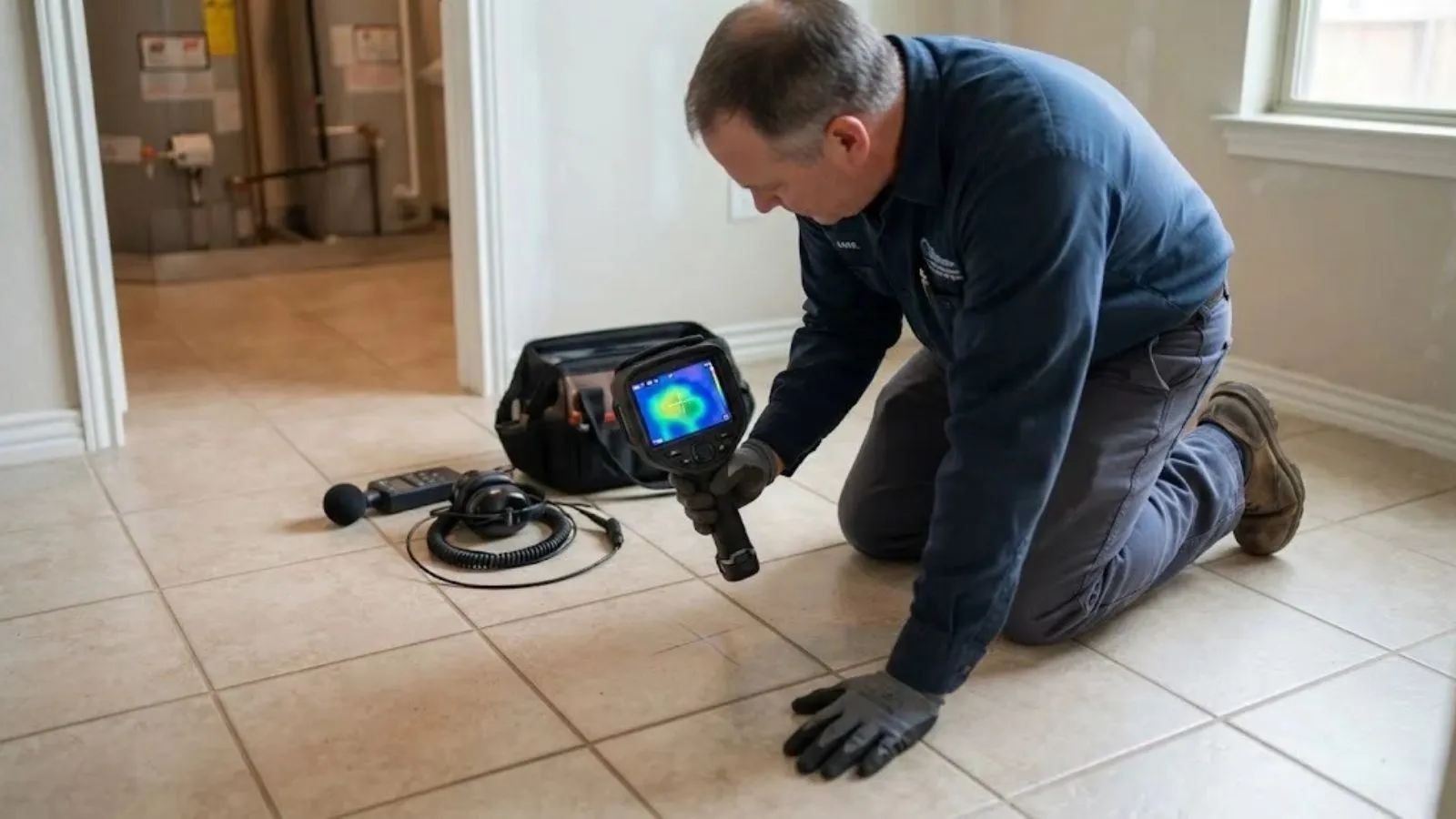
For a leak inside the house, a plumber can isolate each branch with pressure checks and listening gear. Moisture or a warm floor spot can indicate a slab leak, where the pipe runs under concrete. We find the source first and explain the options before any cutting starts.
What to ask the City of Colton water utility
The City of Colton Water Utilities Department runs the meter and the bill, and its customer service line is on your bill and on the city website. Ask three questions: can they check your meter for a stuck or faulty reading, can they pull your usage history, and what is the process to request a leak check.
We do not state any billing adjustment policy here, because we have not verified one. Ask the City whether any adjustment or review exists, what proof it wants, and how long a request takes. Keep the plumber's invoice and your meter photos, since they are the proof most utilities ask for.
Colton water facts that affect leak hunting
The City of Colton's Consumer Confidence Report says the Water Utilities Department serves about 90 percent of the city through more than 10,500 connections. So check your bill to confirm that the City, and not another provider, is your water supplier before you call it. A different provider has a different meter and a different phone line.
The report lists hardness averaging about 207 mg/L, which is very hard on the USGS scale. Scale builds on toilet fill valves and flappers and keeps them from seating, so a toilet leak is a good first suspect. Wipe a flapper with your finger: a gritty film is a sign it may need replacing.
The City's housing data shows about 52 percent of homes were built before 1980 and about 49.6 percent of homes are rented. Older homes mean older supply lines and shutoffs, and renters should tell their landlord about a meter that moves, since the lease usually says who calls the plumber.
If you live just outside the city line, such as in Grand Terrace or Bloomington, a different water provider handles your meter, so start with the name on your bill. Pressure regulators and shutoff valves installed after a leak is found are covered by the California Plumbing Code, which is based on the Uniform Plumbing Code (UPC).
Frequently asked questions
Water is flowing somewhere. The usual causes are a toilet flapper, an irrigation leak, a weeping relief valve, or a leak in a buried line. The meter test narrows it down.
Look for a small dial, triangle, or star that turns when even a tiny flow passes. With every fixture off, it should be still. If it moves, you have a leak.
Put a few drops of food coloring in the tank and do not flush. After fifteen minutes, color in the bowl means the flapper is leaking. Replace the flapper and repeat the test.
Ask the City of Colton Water Utilities. Call the customer service line printed on your bill and ask about a meter check and a leak check request. We do not know their current process, so confirm it with them.
Yes. Many leaks are underground, inside walls, or in the toilet bowl, and show up only as extra water on the meter. Check the bill each cycle.
Look at your latest water bill for the provider name and phone line. The City serves about 90 percent of Colton proper, so a few addresses use another provider. If your bill does not come from the City, call the provider listed on it.