
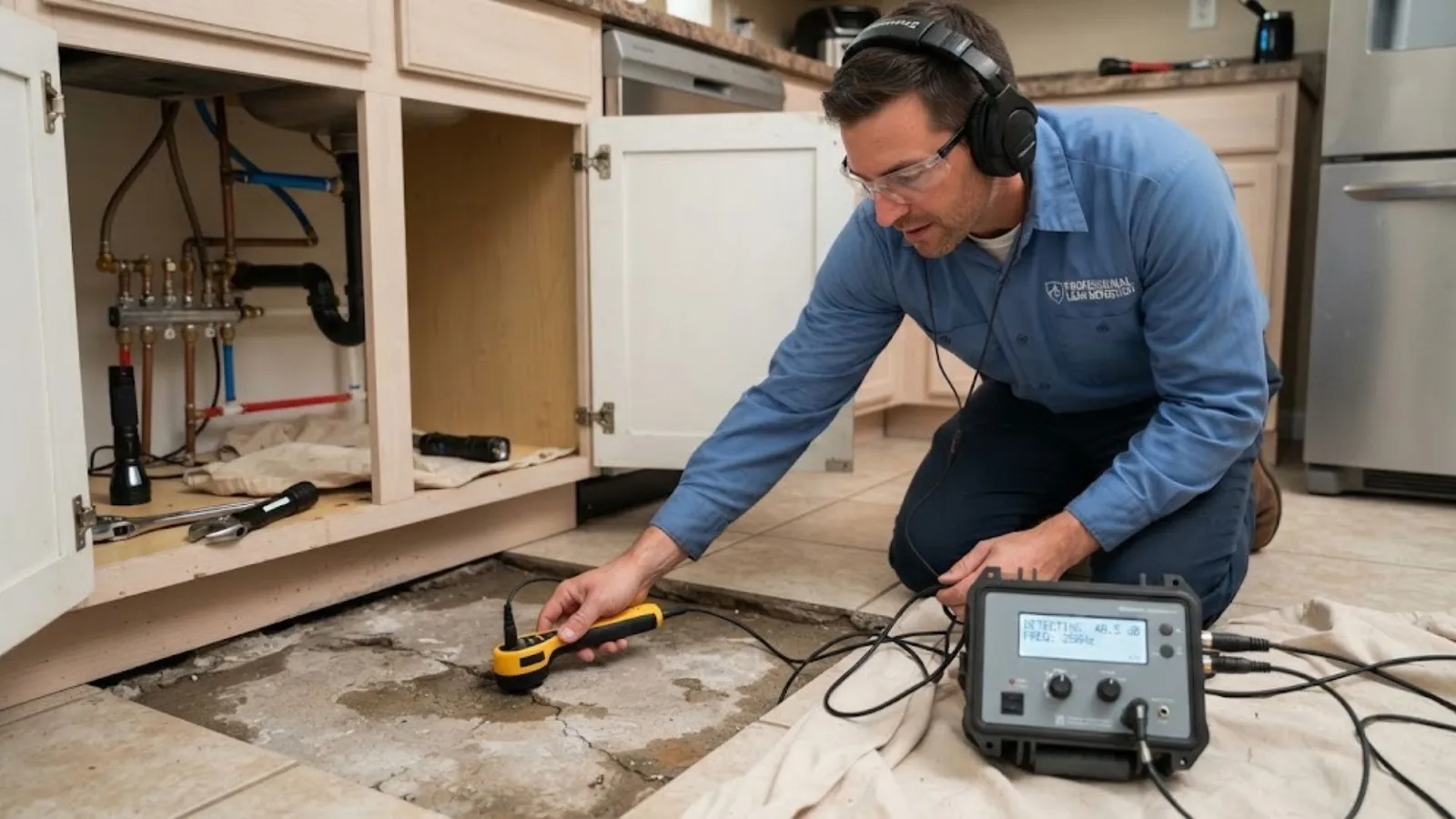
Warm floor spots, hissing sounds and a spinning meter: how a slab leak shows itself
The clearest sign is heat. A leaking hot water line under the slab warms the concrete above it, so one patch of tile or carpet feels warm to bare feet. Other signs include the sound of running water in a quiet house, damp or buckled flooring, a musty smell, baseboards that stain or swell, and a bill that jumps with no change in habits.
A fast check is the meter test. Turn off every fixture, then watch the meter's low-flow dial at the curb box. If it moves, water is escaping somewhere. Close the main house valve and look again. If the meter now stops, the leak is on the house side, which includes the slab.
None of these signs prove the leak is under the concrete. A leaking water heater, a wall leak or a running toilet can look similar. That is why a technician confirms the location before anyone cuts the floor.
Suspected slab leak right now: shut the water and protect the floor
Treat a confirmed or suspected slab leak as urgent, because water under a slab can undermine flooring and run up a large bill quickly. The 24/7 line is open at night and on weekends, and same-day appointments are available when schedules allow. These steps help while you wait.
- Shut off the main water valve. Turn it fully clockwise. If it will not move or does not hold, call the utility's after-hours line to have water stopped at the meter.
- Keep electricity away from wet floors. Unplug devices on or near damp flooring and stay off the area if water reaches outlets. Do not touch wet electrical equipment.
- Lift valuables and rugs. Move furniture, boxes and rugs off damp flooring so they do not wick up moisture.
- Photograph everything before cleanup. Take photos and video of warm spots, wet flooring and the meter reading for the insurer.
- Do not drill or chip the slab. Cutting a guessed spot can hit another line, a gas line or electrical conduit, and it rarely hits the leak.
Spot repair, overhead reroute or pipe lining: picking the fix for a slab leak
Each option trades floor disruption against long term value, and the pipe's condition decides which one fits.
| Option | How it works | Best when | Limit |
|---|---|---|---|
| Spot repair through the slab | A small section of concrete is opened over the leak and the pipe is repaired | One isolated failure in otherwise sound pipe | Other weak spots on the same line can fail later |
| Reroute above the slab | A new line is run through walls or the attic and the old one is abandoned | The pipe under the slab is worn in several places | Needs wall and ceiling access and patching |
| Epoxy or lining | A resin coating is applied inside the old pipe to seal it | The pipe is intact enough and the fittings are suitable | Not suitable for every pipe, and does not fix a broken or collapsed section |
| Full repipe | All supply lines are replaced | Pipes are old and failing throughout the house | Largest project, see our repiping page |
A technician should explain which of these your pipe can actually support before any work begins.
Why pipes under concrete fail in the first place
Most slab leaks come from a few mechanisms. Copper can corrode from the outside when it sits in aggressive soil or touches concrete and steel, and from the inside when water chemistry attacks the wall. Vibration and flow noise can wear a pipe against a rough edge or a joint. Poor bedding or sharp fill can also put pressure on the pipe from day one.
High water pressure adds stress to every joint. A house with pressure well above normal ages its pipes faster. Ground movement, even small shifts, can bend or kink a line enough to crack it over time. Hot water lines tend to fail sooner than cold lines because heat expands the metal repeatedly.
None of this means every slab home will have a leak. It means a leak is more likely when the pipe is old, the pressure is high or the soil is harsh, and checking pressure is cheap insurance. Slab homes are the ones this page covers. If your home has a crawlspace instead, the repair is different and described on our leak detection page.
What drives the cost of repairing a leak under the floor
Slab leak work ranges from a short spot repair to a major reroute, so the final cost depends on a few concrete things we confirm on site.
After the leak is found: water damage and insurance steps
A few steps early on make repair and claims go more smoothly.
- Keep dated records. Save the meter readings, the bill history and photos of every affected room.
- Call your insurer before work. Ask what your policy covers, whether it requires an adjuster visit and how it wants documentation.
- Dry the area quickly. Fans, dehumidifiers and lifting wet flooring limit mold risk. Mold can start within a couple of days in damp conditions.
- Keep damaged materials until approved. Do not throw out wet flooring or drywall until the insurer has seen it or told you it is fine.
- Get the repair scope in writing. A written scope lists the pipe, the opening and the restoration, so you can compare it with the insurer's estimate.
Colton's older housing and hard water: how they relate to under-floor leaks
According to the City of Colton's housing data, about 52 percent of homes in Colton were built before 1980, and the largest single share, 28.5 percent, was built in the 1980s. We have not verified how many Colton homes sit on slabs, so we do not claim a share. What the age does tell you is that many homes have plumbing that is decades old, which makes pipe condition worth checking when a leak appears.
The City's 2024 water quality report lists average hardness at about 207 mg/L, around 12 grains per gallon. Hard water leaves scale inside pipes and fixtures over time. Scale does not itself prove a pipe is bad, but a technician will look at the inside of a cut pipe to judge how much metal is left.
When a slab leak is not the right diagnosis
Sometimes the warm spot is a different problem. A water heater leaking at its base, a wet wall with a pipe inside it, a sewer line backup or a failed drain under the slab can each look like a supply leak. Drain leaks do not make the meter spin, and a sewer problem usually brings slow drains or odors. We confirm the diagnosis before recommending any floor work.
If the evidence points to a burst pipe in the open, see burst pipe repair. We serve homes across Colton and nearby towns such as Rialto. For help right now, call the 24/7 line.
Frequently asked questions
Yes. The 24/7 line takes slab leak calls overnight and on weekends in Colton. Same-day appointments are available when schedules allow. Close the main valve while you wait.
Common signs are a warm floor patch, the sound of running water, a spinning meter with everything off, damp flooring and a sudden bill increase. A technician confirms it with listening equipment and a pressure test.
It is better to shut the main valve and stop using water. Leaving it on lets water keep soaking the base of the house. If you must use water, turn the main on briefly and close it again.
Not always. A reroute above the slab avoids opening the floor, and lining works from inside the pipe. A spot repair does need a small opening. Your technician explains which option the pipe supports.
Treat it as urgent. Slab leaks rarely flood a house all at once, but they waste water, damage flooring and can undermine the base of a house the longer they run. Shut the water off and call.
A resin coating is applied inside the old pipe to seal leaks and slow further corrosion. It suits some pipes in decent shape. It does not fix a collapsed or fully broken pipe, and it depends on fittings that can accept it.
Coverage varies. Many policies cover sudden water damage and sometimes the access to reach the leak. They often exclude the pipe itself and wear or corrosion. Ask your insurer before work begins.
It depends on the work. Replacing or rerouting pipe may require a permit. Ask the City of Colton Building Division which applies to your repair.