
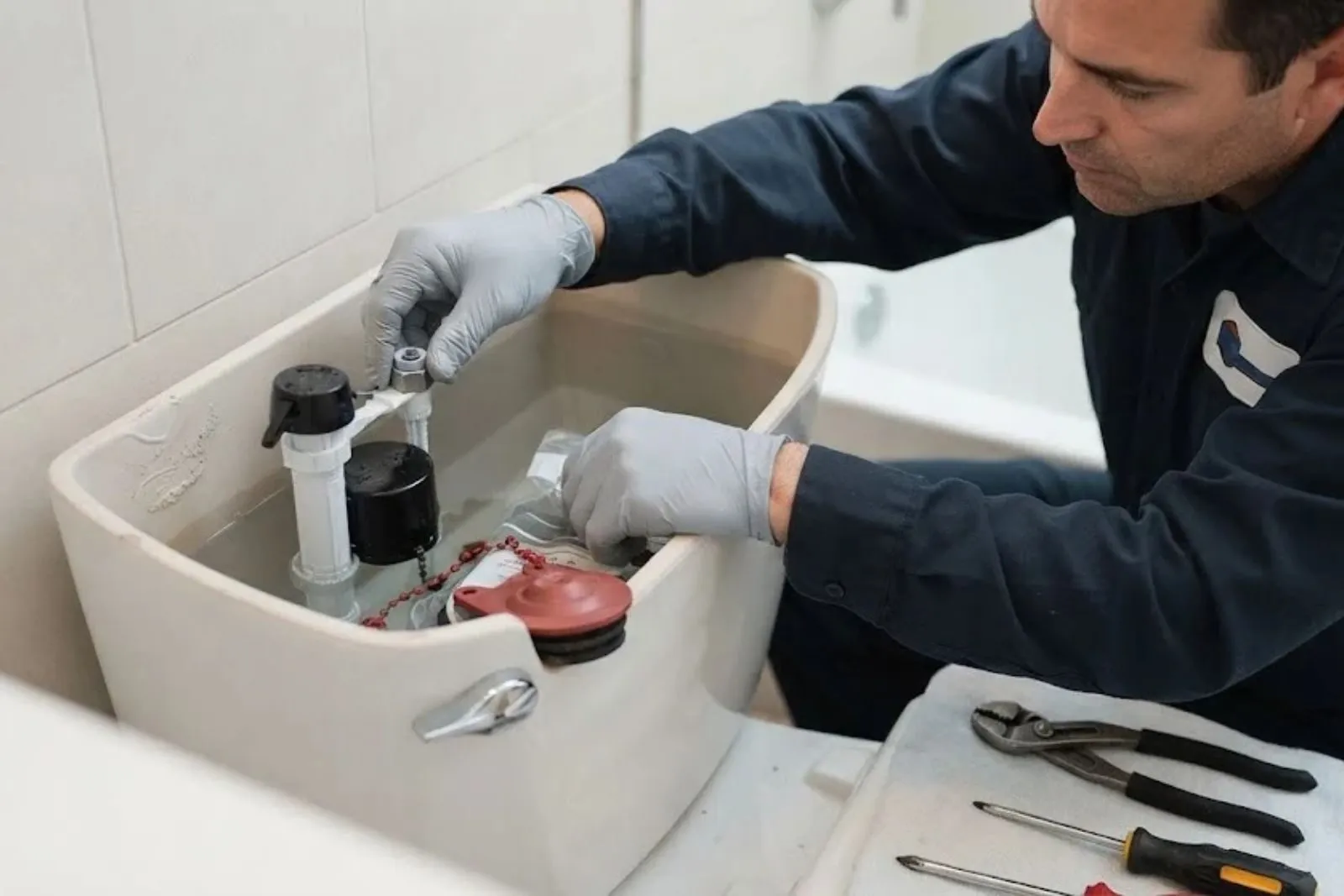
What fails inside a toilet that has stopped behaving
A toilet is a simple machine with three zones. The tank holds the fill valve, the float, the flapper and the overflow tube. The bowl and trap hold water and use a siphon to pull waste into the drain. The base seals the bowl to the floor flange with a wax ring or a rubber gasket.
Each zone fails in its own way. Tank parts wear out, swell or collect scale. The siphon fails when a clog or a weak flush starves it of water. The base fails when the seal dries, shifts or loses its grip on a flange that sits too low or has cracked.
That is why the first job is sorting the symptom into a zone. A weak flush with a normal tank points to the bowl side. Water on the floor only after flushing points to the base. A hiss that never stops points to the tank.
The running toilet that wastes water all day
A toilet that runs on and off, or hisses after the tank looks full, is leaking water from the tank into the bowl or down the overflow tube. It rarely floods anything, so people live with it. The cost shows up on the water bill instead.
You can test it in ten minutes. Add a few drops of food coloring to the tank, do not flush, and wait. If color reaches the bowl, the flapper or its seat is leaking. If the water level sits at the top of the overflow tube, the fill valve is not shutting off.
Both fixes are small parts, but a worn flapper often comes back if the seat is rough with mineral buildup. We clean or replace the seat surface along with the part, which is what keeps the repair from repeating.
Toilet symptoms and the part usually behind them
This table matches what you see to the likely cause and the usual repair.
| What you notice | Likely cause | Usual repair |
|---|---|---|
| Water keeps running or hisses | Worn flapper, scaled seat, or fill valve that will not shut off | New flapper, seat cleaning, or fill valve replacement |
| Bowl rises and drains slowly | Clog in the trap or the line beyond it | Auger the toilet or clear the drain line |
| Toilet rocks side to side | Loose closet bolts, uneven floor, or failed wax ring | Reset the toilet with a new seal and shims |
| Water pools at the base after flushing | Failed wax ring or cracked flange | Pull the toilet, replace the seal, repair the flange |
| Handle feels loose or flush is weak | Broken chain, lift arm or low tank water | Adjust or replace the flush linkage |
| Supply stop drips or will not turn | Worn packing or corroded stem | Replace the supply valve and connector |
A final diagnosis needs a look at the toilet. Several symptoms can overlap.
Rocking toilets, wax rings and a damaged floor flange
A toilet that moves under you has lost its seal, or soon will. The wax ring is a soft gasket between the bowl horn and the closet flange. Rocking breaks the wax, and then sewer gas and water slip past it. You may smell it before you see any water.
The flange is the ring bolted to the floor that holds the toilet down. If it is cracked, rusted or sitting below the finished floor after new tile went in, a new wax ring alone will not hold. We check flange height, test the bolts and look for soft subfloor before choosing a repair ring or a different seal.
Caulk around the base does not fix a leak that comes from under the bowl. It can also hide the first drips and let the subfloor soak. If the floor near the toilet feels spongy, tell us so the technician can check it.
Overflowing toilet right now: what to do first
If the bowl is rising toward the rim, call the 24/7 line and start these steps while we dispatch. Same-day appointments are offered when available, and an overflow reported at night or on a weekend is treated as urgent.
- Shut the supply. Turn the small oval valve behind the toilet clockwise. If it will not turn, lift the tank lid and hold the float up so the fill valve stops.
- Do not flush again. Another flush pushes more water into a blocked trap. Resist the urge even if the bowl looks like it is going down.
- Stop the spread. Lay towels at the door, lift rugs, and move anything valuable off the floor. Wet flooring in a bathroom can spread under walls fast.
- Keep power away from the water. Stay clear of outlets, floor heaters and extension cords that touch the wet area. If water is near a panel, leave it alone.
- Skip chemical openers. Caustic cleaners sitting in a blocked bowl splash onto skin and can damage the porcelain finish or the tech who has to reach in.
From shutoff to final flush test on a toilet call
Here is the sequence a technician follows, so nothing is replaced before the cause is known.
- Isolate and inspect. The tech closes the supply, checks the stop valve for leaks, and looks for water marks on the floor, wall and tank.
- Sort the zone. Tank, bowl or base. A dye test, a visual check of the siphon jet and a gentle rock test separate the three.
- Clear or repair. A clog is augered. A worn part is replaced. A leaking base means the toilet comes up, and the old wax and flange are examined.
- Quote before work. You see a clear written price once the cause is known and before parts are changed, with repair and replacement options laid out.
- Test under load. The tech refills, flushes several times, checks every joint with a dry paper towel and confirms the shutoff holds.
What drives the price of a toilet repair
A toilet repair can be a single part or a floor repair, so one number does not fit every call. These are the factors that move the price.
Repair, replace, or treat the clog as a separate job
Repair makes sense when the porcelain is sound and the problem is a part. Replacement makes sense when the bowl or tank is cracked, the toilet clogs even with a clear drain, or the cost of parts and labor approaches a new unit. A new install also lets you fix a rocking base with a fresh flange. Our plumbing installation team sets new toilets as part of a repair visit when that is the better call.
A toilet that clogs again and again is sometimes a symptom, not the problem. If a sink or tub also gurgles or drains slowly, the blockage may sit in the line downstream of the bowl. That calls for drain cleaning rather than another round of plunging.
Mention the wax ring, fill valve, supply valve or flange you suspect when you call. These are everyday parts, and the tech can bring the right ones. A toilet in a unit near Grand Terrace or a Colton rental follows the same process.
Colton hard water and older homes change toilet repairs
The City of Colton's water quality report lists average hardness near 207 mg/L, which is roughly 12 grains per gallon and falls in the very hard band on the federal scale. In a toilet tank, that mineral content can crust the flapper seat and clog the small screen in a fill valve. A clean seat and a fresh part usually outlast a part swapped onto a rough seat.
About 52 percent of Colton homes were built before 1980. In those houses the stop valve behind the toilet is often original. Valves that have not been turned in decades can seize, or start to drip the moment they are moved. Test yours once a year, and tell the technician if it resists so a replacement can be planned into the visit.
Replacement toilets and flanges are installed to the California Plumbing Code, which is based on the Uniform Plumbing Code (UPC), so ask the Building Division if a job involves moving a fixture.
Frequently asked questions
Yes. The 24/7 line is staffed around the clock, and an overflowing toilet or a leak spreading from the base is dispatched as urgent. Same-day appointments are offered when available, and shutting off the valve behind the bowl while you wait limits the damage.
Usually the flapper is not sealing, so water leaks from the tank into the bowl and the fill valve tops it up every few minutes. A rough seat from mineral scale or a stretched chain can cause it. A dye test in the tank will confirm the leak.
Yes, once the supply is shut off and the bowl is no longer rising. Use a flange plunger, seat it fully, and push gently at first to avoid splashing. If two or three tries do nothing, stop and call, because a deeper blockage will not give to more force.
Loose bolts, an uneven floor or a damaged flange can all cause rocking. If the toilet has rocked for a while, the wax ring has probably lost its seal and should be replaced when the toilet is reset.
It does not crack the porcelain, but scale can foul the flapper seat, the fill valve screen and the rim jets. That leads to running tanks and weaker flushes. Cleaning or replacing those parts restores normal operation.
Repair if the porcelain is sound and only a part has failed. Replace if the bowl or tank is cracked, if it clogs even with a clear drain, or if repairs keep stacking up. The technician can lay out both options before any work starts.
Yes. These are routine toilet parts, and a flange repair is a common reason for a visit when a toilet will not stay sealed. Tell us which one you suspect when you call.