
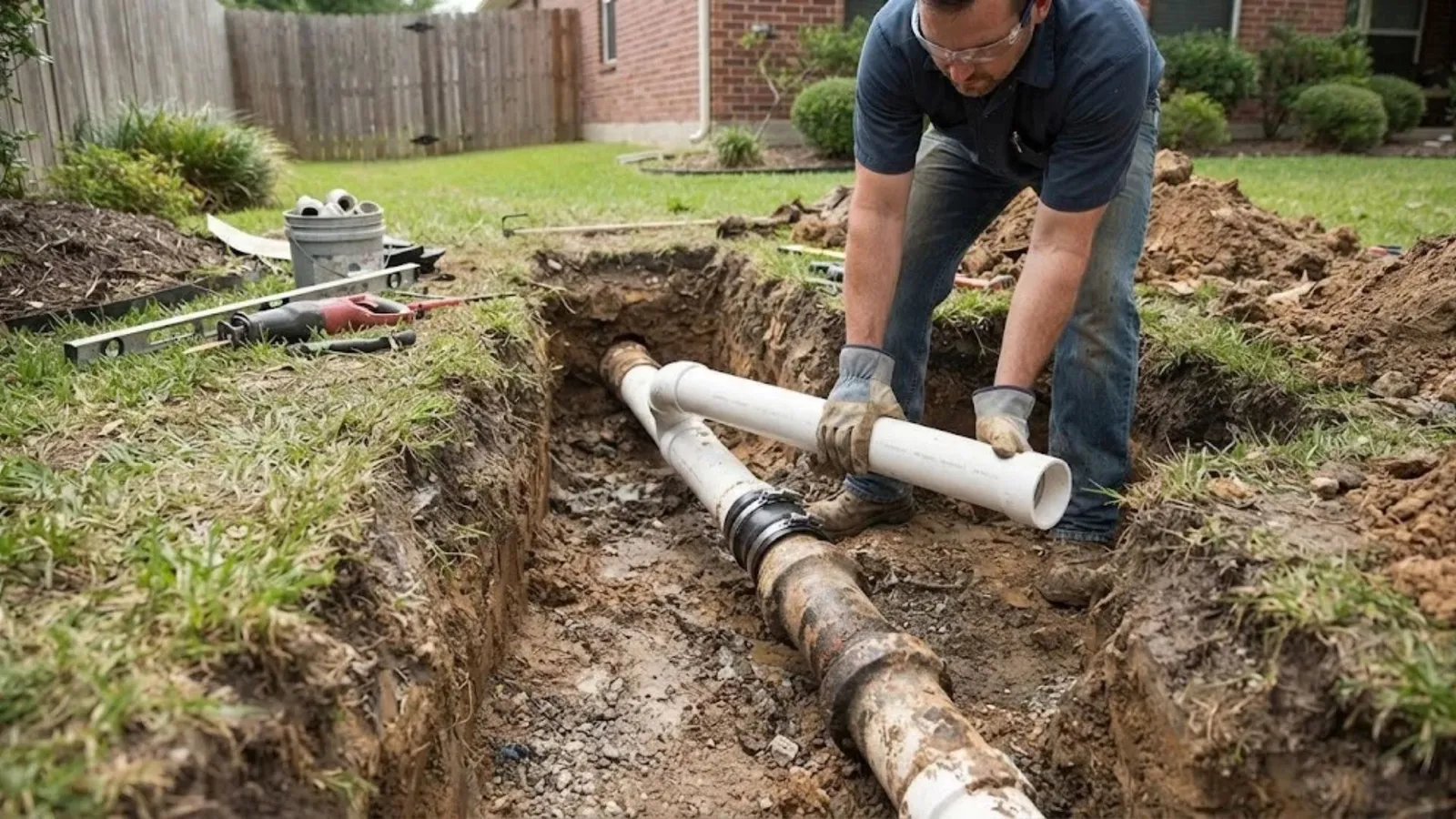
Five reasons a buried sewer pipe cracks
Most failures come from a slow process, not a single event.
Tree and shrub roots
Roots follow moisture to a joint, slip inside, and grow. Over time they pry the joint apart and can split the wall.
Ground movement
Soil that settles or shifts bends a rigid pipe. Clay and cast iron crack rather than flex.
Age and wear
Pipe and joints weaken after decades of flow and soil load. Rough interior walls then catch debris.
Cast iron corrosion
Iron rusts from the inside, flaking and thinning the wall until it cracks or collapses.
Offset joints
Where one section sits lower than the next, waste drops into the gap and the edge catches solids, so backups repeat.
How a camera inspection finds the crack
A small waterproof camera, the heart of a sewer inspection, on a flexible cable goes in through a cleanout. The tech watches a live feed and notes the footage counter as the camera moves. That number tells them how far from the cleanout the damage is.
A locator at the surface picks up the camera's signal, so the tech can mark the ground above the problem. This matters for a spot repair, because the dig has to be in the right place. Ask for a copy of the video, which also helps with quotes from other contractors.
Cracks usually show as lines, missing pieces, or gaps with soil visible. Roots appear as thin white threads or thick mats. A belly, where the pipe sags and holds water, shows as a pool at the low point.
Spot repair, lining, or replacement: the trade-offs
No method wins every time, so match it to the pipe condition.
| Method | Best when | Limits |
|---|---|---|
| Spot repair (dig and patch) | One or two isolated cracks and a sound pipe elsewhere | Needs excavation at each spot, and other weak spots may remain |
| Cured-in-place lining | Cracks or root entry along a pipe that still holds its shape | Cannot fix a collapsed or deeply offset pipe, and it slightly reduces the bore |
| Pipe bursting | Old pipe that is failing along its length | Needs entry pits, and nearby utilities must be located |
| Full replacement by trench | Collapsed, bellied, or heavily corroded runs | Most disruptive to landscaping and paving |
If sewage is backing up right now
Act on these while you wait for a plumber, because a backup spreads quickly.
- Stop using water. Do not run the dishwasher, washer, showers, or faucets. Every drop goes toward the blockage.
- Keep people and pets away. Sewage contains bacteria. Keep children out of the area and wear gloves and boots if you must enter.
- Do not pour chemicals. Drain cleaners will not clear a crack and can burn skin or damage a liner later.
- Open the cleanout cap carefully. If backed-up waste is visible there, a pressure release may help, but stay clear because it can spill.
- Photograph the damage. Take pictures before cleanup for an insurance claim, and ask the insurer what they cover.
Choosing between a patch and a long-term fix
A patch is cheaper today, but it can cost more over time if the rest of the pipe is also tired. A camera video helps here. If the footage shows the same cracks, roots, and flaking every few feet, a single patch buys little.
Lining has a sound track record on pipes with minor cracks and root entry. But it needs a clean, pre-cleared pipe, and it will not solve a sagging section. Replacement costs the most in disruption and gives the cleanest start. In many cases the camera view makes the choice plain.
What shapes a sewer crack repair quote
We give no dollar figure here because the range between a spot patch and a long replacement is wide. These factors set the price.
Who owns the sewer in Colton and what to ask the City
The City of Colton's service provider page says the City owns and operates the sewer system. That is why, when you have a backup, one of the first questions is whether the blockage is in your private lateral or in the city main. Ask the City utility to check the main if other homes on your street are also backing up.
About 52 percent of Colton homes were built before 1980, based on the city's housing data. Older homes are more likely to have older materials, and the camera will show you what you have. Do not assume your pipe type until the footage shows it.
California law requires a call to 811 or DigAlert at least two working days before digging, which applies to a spot repair or a trench. Ask the City of Colton Building Division whether a sewer repair needs a permit and what inspection follows. If you are selling, ask your agent what the sale paperwork requires on the sewer line rather than assuming.
The same questions come up in nearby San Bernardino and Rialto, though the sewer provider may differ there, so confirm yours before you call. Repairs to a sewer pipe are code work under the California Plumbing Code, which is based on the Uniform Plumbing Code (UPC), and the City of Colton Building Division can confirm what needs a permit.
Frequently asked questions
Repeated backups, gurgling drains, soggy patches in the yard, and a sewage smell are common signs. Only a camera inspection confirms a crack. Ask for the video so you can see it yourself.
No. A crack usually grows as soil moves and roots enter. Waiting makes a small repair into a big one, and it risks a full backup.
Lining avoids a long trench and can seal cracks and root entry in a pipe that holds its shape. It does not work on a collapsed or badly offset pipe. The camera footage decides.
It depends on where the break is, so ask the City of Colton which section of the line is yours and which is the City's. Then check your insurance policy for what it covers.
Not always, because roots can enter at an open joint. Roots do point to a gap, though, and cutting them without sealing the gap means they grow back. Hydro jetting can clean the pipe and prepare it for lining.
The city's housing data shows a large share of homes built before 1980, and older pipes tend to have more joints and more wear. A camera run shows whether the cause is a belly, roots, or a crack.