
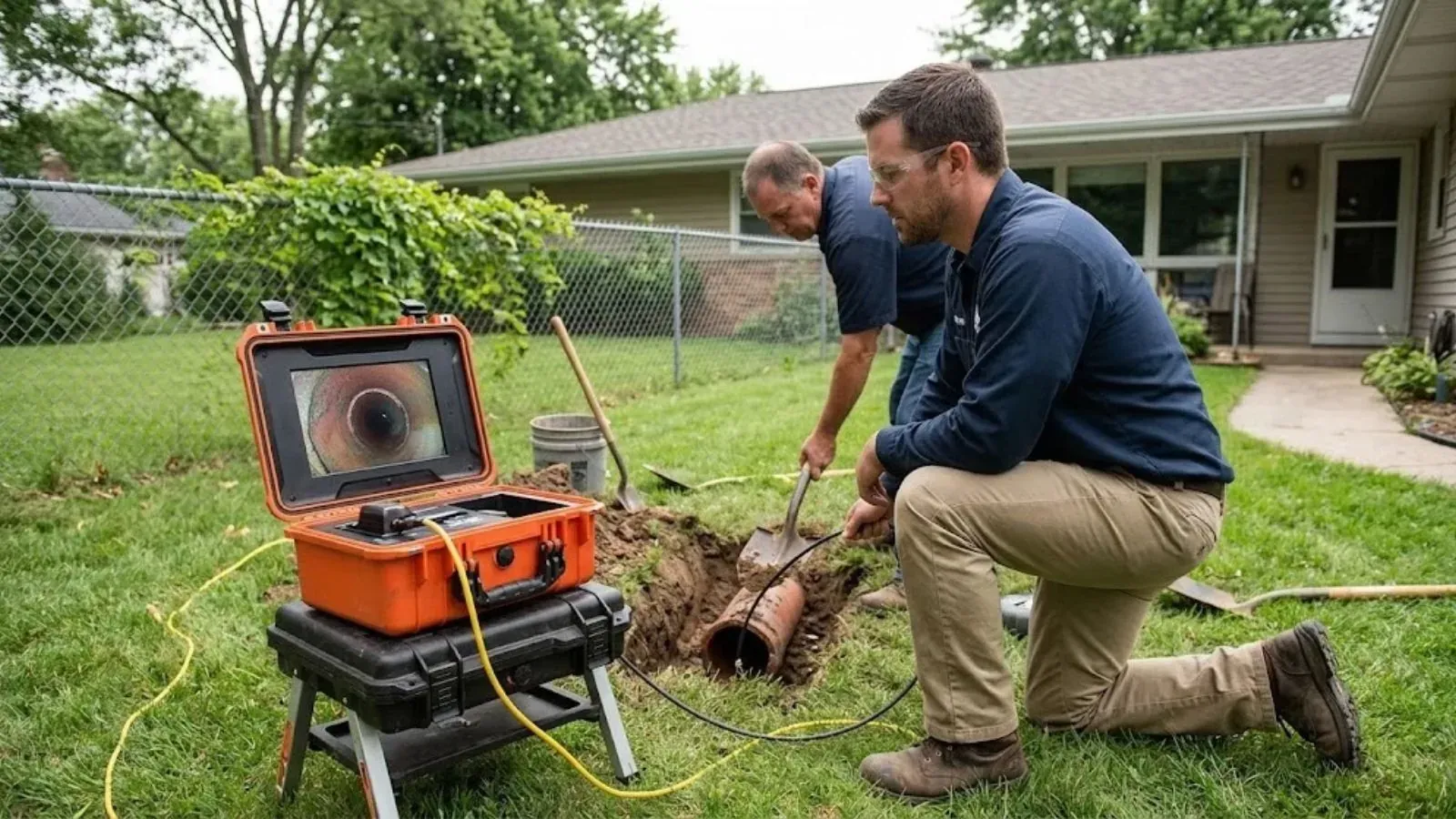
The camera and locator: what the equipment is and how it works
A sewer camera is a small, waterproof lens with lights, mounted on a flexible push rod that winds off a reel. It goes into the line through the cleanout and feeds live video to a monitor on the surface. The video is recorded so the home owner can review it afterward.
A transmitter sits just behind the camera head. It sends a signal that a handheld receiver picks up from above ground. The technician walks the yard, finds the signal at its strongest and marks the surface position. The receiver also reads the depth of the pipe at that point.
Locating is how we say where a problem is. The footage shows a defect at a certain distance along the rod, and the locator ties that distance to a spot in the yard, a driveway or a wall.
What the recording proves and what it does not
A video proves what the camera passed. It shows the pipe material, cracks, roots, offset joints, scale, sags with standing water and obstructions. It documents the condition on the day of the inspection.
It does not prove how long a defect has existed, how fast it will worsen or whether a section the camera could not reach is sound. It cannot see through a full line, so a heavily blocked pipe may need clearing before the inspection. It also cannot tell us who is responsible for the pipe, which depends on the sewer agency and the property line.
Reading the video: common findings and what they usually mean
Technicians read the picture for shape, color and pattern.
| What appears on screen | What it usually means | Typical next step |
|---|---|---|
| Fine hair-like threads at a joint | Root intrusion through a leaking joint | Clear roots and decide on a joint repair or lining |
| Rough, dark scale on the wall | Corrosion in cast iron or mineral build-up | Clean the line and reassess condition |
| Standing water in a section | A belly where the pipe settled | Monitor or correct the slope with a repair |
| A split along the pipe or a missing piece | A crack or break | Spot repair, lining or replacement |
| Pipe ends not lined up | An offset joint | Repair, since offsets catch solids |
Locating depth and position along the line
The locate gives two numbers that matter for any dig: how far along the line the defect is, and how deep the pipe lies at that point. Depth helps decide between a short spot repair and a trenchless method, since shallow pipe is cheaper to expose.
The technician marks the surface with paint or flags. The marks guide a repair crew, and they also help avoid damaging other buried lines. Before digging, California law requires a call to 811, DigAlert, at least two working days ahead, so utility lines are marked.
A locate has limits. Signals can be weakened by metal, deep pipe or interference from other lines, and the depth reading is a measurement and not a survey. If the result is unclear, the technician says so and explains how to confirm it.
What to prepare before the camera goes in
A few things make the visit faster and the video clearer.
- Find the cleanout. Clear plants, boxes and soil from around it. Our technician can locate it if you cannot.
- Note the symptoms. Write down which fixtures back up, how often and since when. The pattern tells us where to look.
- Hold off on heavy water use. Skip laundry and long showers just before the visit so the line is as clear as possible.
- Gather paperwork. Any earlier plumbing records, a sketch of the lateral or a seller disclosure help us read the video.
- Tell us about gates and pets. The technician needs to walk the yard to follow the signal.
- Plan for a short wait. The visit includes setup, the run, the locate and a short review of what the video shows.
How an inspection runs from cleanout to written findings
A typical visit follows these steps.
- Open the cleanout. The technician checks for standing water or pressure before removing the cap.
- Run the camera. The rod is fed in toward the house or the street, and you can watch the screen live.
- Mark defects. Each defect is noted by distance. The locator marks the surface position and reads depth.
- Review the footage. We explain what each finding is and whether it needs action now or monitoring.
- Receive the recording and plan. You keep the video and a written summary, then choose whether to clear, repair or watch.
What affects the cost of a sewer camera inspection
An inspection costs less than a repair, and it often prevents paying for the wrong one. The price depends on a few things.
Buying a home: why a sewer camera inspection is worth asking for
A standard home inspection looks at visible plumbing but not the buried sewer lateral. A camera inspection can reveal roots, a collapsed section or a belly before closing, when you can still negotiate the price or ask for repairs.
Ask the seller for access to the cleanout and arrange the inspection within the contingency period. Pass on the video to your agent so it supports the discussion. A clean video is also a useful baseline for the future.
The video does not predict the future. A pipe in good shape can still develop problems, but you will know its condition on the day you bought. For findings that call for action, our sewer line repair page lays out the options, and sewer line cleaning covers routine clearing. If you are buying in Loma Linda, our Loma Linda plumbing page shows how we serve that area.
Colton homes by era and what that means for the lateral
City housing data lists about 52% of Colton's homes as built before 1980, 28.5% built in the 1980s, and a small share built after 1999. Older homes may have clay or cast iron laterals, and homes from the 1980s may have early plastic. The camera confirms the actual material for your property.
Colton's hard water, averaging about 207 mg/L according to the city's water quality report, does not enter the sewer lateral directly. It matters more for hot-water fixtures and drain scale, which the video can also show in the lines near the house.
For permits or inspection rules for any repair that follows, contact the City of Colton Building Division at 659 North La Cadena Drive.
Frequently asked questions
Yes. Our inspections use a waterproof push camera with a transmitter in the head and a handheld locator on the surface. You can watch the video live and keep the recording.
Yes. The locator reads depth at the marked point. It is a measurement and not a survey, and metal or interference can reduce its accuracy, which we tell you on site.
Yes. Cracks, root threads, offset joints, scale, sags with standing water and obstructions are visible when the pipe is clear enough to see.
Then the line has to be cleared first, since the camera cannot see through a full pipe. After clearing, we run the inspection to see why it blocked.
No. The video shows condition and location. Responsibility depends on where your private line meets the public sewer, so ask the sewer agency that serves your address.
It is a good idea, especially for older homes, since the buried lateral is not covered by a standard home inspection. The video can support a price discussion or a repair request.
Yes, when a line is backing up. We usually clear the blockage first and then run the camera. The 24/7 line takes those calls at any hour.