
Signs the main line is blocked, not one drain
A main blockage shows up in more than one place.
Lowest drain backs up first
Water in a shower or floor drain at the lowest level when a toilet upstairs is flushed. Gravity sends the overflow to the lowest opening.
Toilets gurgle when the washer runs
Air is being pushed back through a partly closed main. The sound is a warning that capacity is limited.
Several fixtures drain slowly
A sink, a tub and a toilet all slow together. A single clog would affect one fixture.
Floor drain bubbles or smells
A bubbling basement or garage drain suggests the line beyond it is full.
Water stands in the cleanout
If the cleanout cap is opened by a technician and water is visible, the blockage is downstream of that point.
Where the cleanout is and how a technician uses it
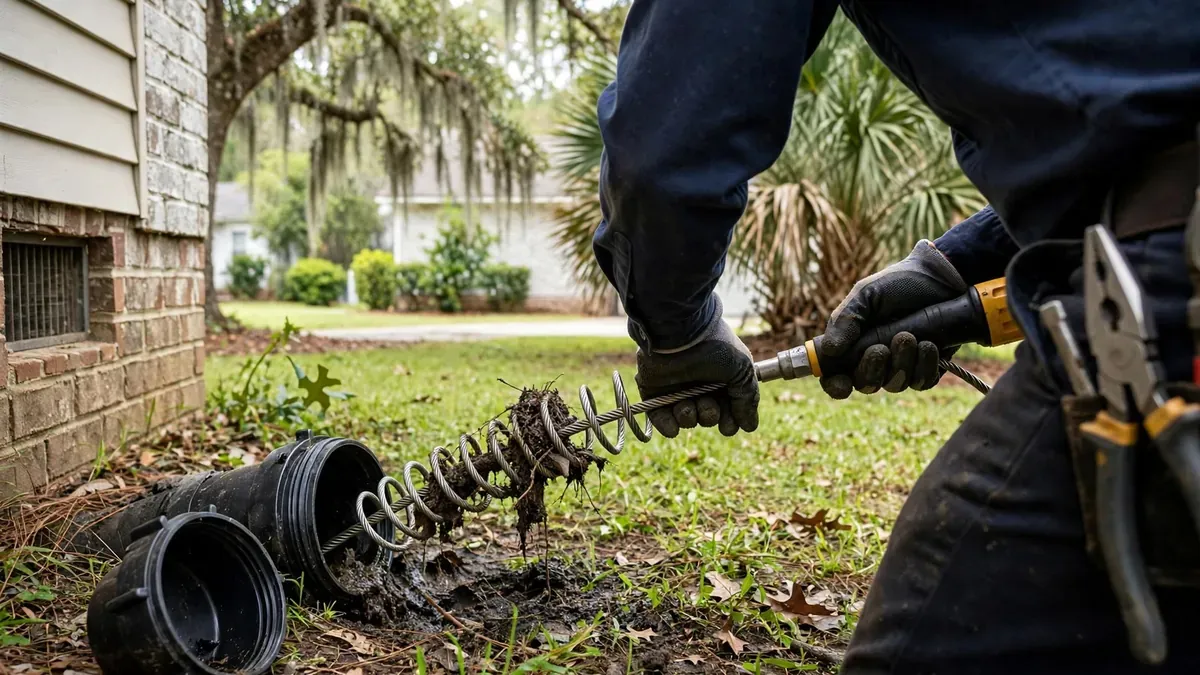
The cleanout is a capped pipe, often white or black plastic or older cast iron, that gives direct access to the main. Common places are near the foundation on the exterior wall closest to the street, in a side yard, beside the garage or in a small ground box. Some homes have one inside, in a basement, crawlspace or utility area.
Technicians open the cap slowly and feed a cable or jetting hose along the pipe. Access matters because a cleanout lets the machine start close to the main, instead of entering through a toilet. Without a cleanout, the toilet or a roof vent may be the entry point, which takes more time and care.
If you cannot find it, describe where the sewer line leaves the house. A technician can locate it, and if a cleanout is missing, adding one is a practical improvement.
Main line backed up right now: what to do and what not to do
A backed-up main line is an emergency because sewage can rise in the lowest fixtures. Call the 24/7 line. We schedule same-day and after-hours appointments when available and ask a few questions so the right cable or jetter goes on the truck.
- Stop water use house-wide. That includes laundry, dishwashers, showers and toilet flushing. The line is full.
- Do not open the cleanout cap. A full line can spill out of it. A technician will open it with protection in place.
- Do not pour chemicals. They sit in the pipe and make later work more hazardous.
- Do not rent a drum machine on your own. A rented cable can wedge in a joint, tear a liner or injure the user, and it cannot show what is happening inside.
- Protect floors and belongings. Move items from lower rooms, and keep people and pets out of areas where water has risen.
Cable or jetting through the cleanout: how a main is cleared
For most main-line stoppages the first tool is a large-diameter cable on a drum machine. The head is chosen for the blockage. A spiral head retrieves a plug, a blade cutter slices through roots and a spear head penetrates a dense mat. Cable work opens the line quickly.
When the problem is a coating, a mix of grease and paper, or fine root hairs, jetting follows. The water scours the wall and flushes debris to the public main. Our hydro jetting page explains the method and the pipe condition it needs.
Both are followed by a camera look when the cause is not obvious. The video tells us whether the line is clean and sound or whether something else lies behind the clog.
When clearing is enough and when the pipe needs more
A cleaning solves a blockage, not a defect. The camera separates the two.
| What the camera shows | Likely cause | Is clearing enough? |
|---|---|---|
| Smooth pipe, one plug removed | Paper, wipes or a foreign object | Yes, with a note on what to keep out of drains |
| Grease or scale coating | Slow build-up over years | Yes, with jetting, and repeat if it returns |
| Roots entering at a joint | A leaking joint or crack | Short term only. Joint repair or lining prevents regrowth |
| Standing water in a low section | A belly where the pipe settled | Short term only. Correcting the slope needs repair |
| Broken, missing or collapsed pipe | Structural failure | No. Repair or replacement is needed |
Our sewer line repair page covers the cases where the pipe is the problem.
Mistakes that turn a blocked main into a worse problem
These habits clog mains or make a blockage harder to clear.
- Flushing wipes labeled flushable. They do not break down like paper and tangle with roots and grease into dense plugs.
- Pouring grease down the kitchen drain. It travels warm and sticks as it cools. Wipe pans and bin the fat.
- Ignoring early gurgling. A partial blockage is easier and cheaper to clear than a full one.
- Blocking the cleanout. Piling soil, planters or a patio over it can delay emergency work.
- Skipping maintenance on a line with roots. A home with known root intrusion needs regular clearing or a repair to end the cycle.
What shapes the price of clearing a main line
A main-line cleaning is priced by access, machine and blockage, not by a single flat figure.
Shared lines, rentals and aging mains in Colton
The City of Colton's housing data shows about 32% of units are in multifamily buildings and nearly half of all homes are rented, 49.6%. In a building with shared lines, a main blockage hits several units. A property manager usually authorizes the job, and routine scheduled clearing is a common way to avoid repeated emergencies.
About 52% of homes predate 1980 and 28.5% were built in the 1980s. Older laterals are more likely to have roots and rough walls, so a line that needs clearing twice in a year should be inspected. Our sewer inspection page shows what the video reveals.
Nearby Grand Terrace and Bloomington homes are served from the same Colton base. See our Grand Terrace plumbing page for that area.
Frequently asked questions
Yes. The 24/7 line takes main line calls at all hours. We ask which fixtures are affected and where your cleanout is, and we offer same-day appointments when available.
Drain cleaning clears one fixture or branch. Sewer line cleaning clears the main line that carries the whole house to the public sewer, and it uses a larger machine through the cleanout.
Look for a capped pipe near the foundation on the street side of the house, in a side yard or by the garage. Some are inside in a utility area. If you cannot find it, we can locate it when we arrive.
Small clogs at a fixture, yes. A main line is different. Standing sewage, the risk of a cable catching and the lack of any view into the pipe make it a job for a trained technician.
It can mean paper or wipes, or it can mean roots and a damaged joint. If the line clogs again, a camera look can find out which.
There is no standard schedule. A line with roots or grease may benefit from regular service, while a clean line needs none. The camera shows how fast build-up returns.
Then the problem is a defect such as a collapse or a belly. We show you the video and explain whether lining, spot repair or replacement fits.