
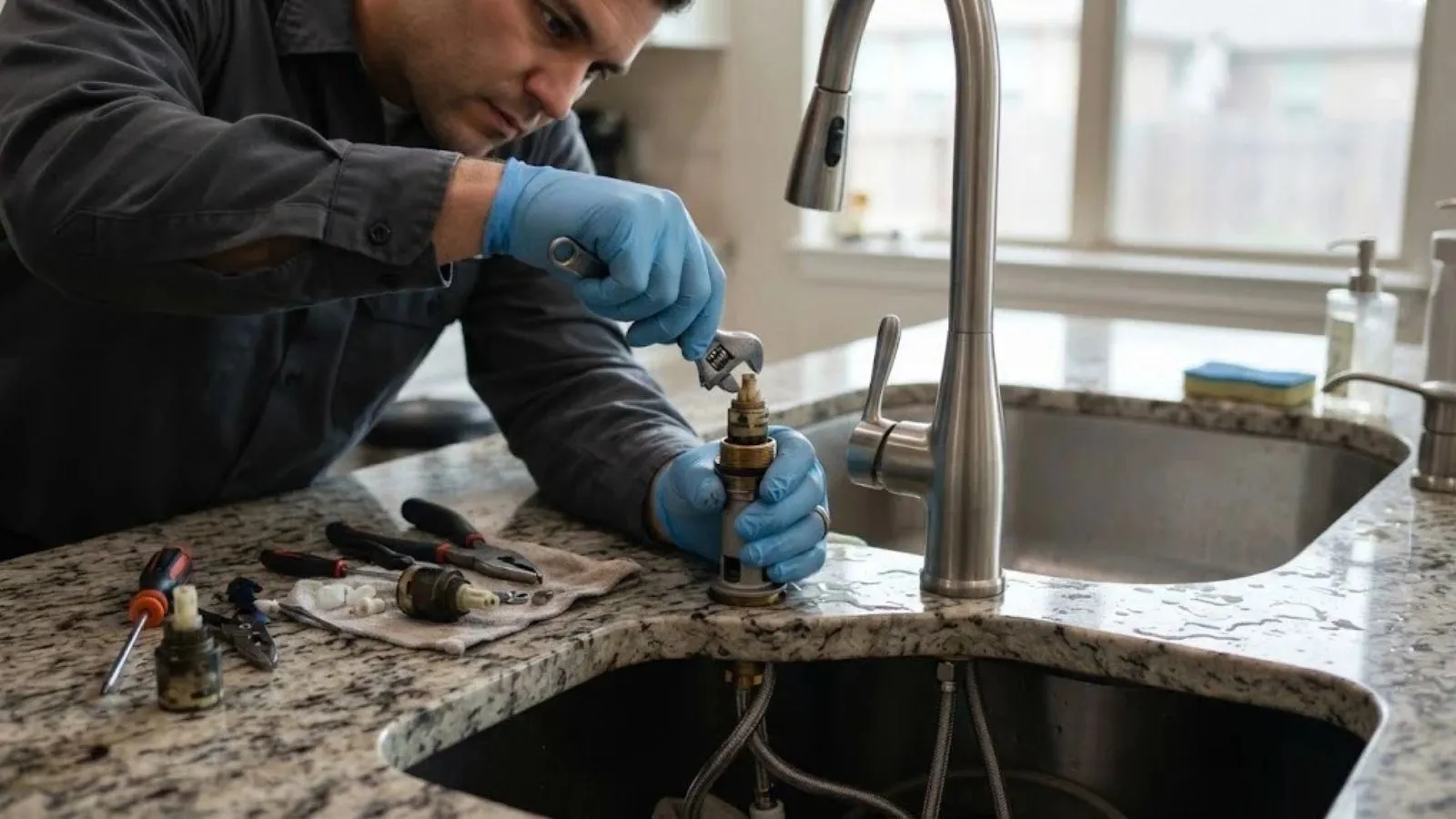
Four faucet types and what usually fails in each
Match what you see when the handle comes off to the row below.
| Faucet type | How to recognize it | Usual drip cause |
|---|---|---|
| Compression (two handles, turn many times) | Handles spin several rotations before water stops | Worn rubber washer or a pitted valve seat |
| Cartridge (single or double handle) | Smooth lever, a metal or plastic cylinder under the handle | Worn seals on the cartridge, or scale inside it |
| Ceramic disc (single lever) | Wide, round body under the handle, often chrome | Cracked disc or worn inlet seals |
| Ball type (single lever, dome cap) | Rounded cap with an adjusting ring under the lever | Worn springs and seats or a leaking O-ring |
Many pull-down kitchen faucets are cartridge or ceramic disc designs.
Where the drip is coming from tells you the part
Watch the water. If it falls from the spout when the handle is closed, the internal valve is not sealing. That points to the washer and seat, the cartridge or the disc.
If water seeps around the base of the handle or the spout swivel, the O-rings are likely worn. Those are small rubber rings that seal the moving joint, and they are cheap and quick to swap. If the pooling is under the sink, look at the supply lines and the shutoff valves before you blame the faucet.
Replacing the worn part, step by step
This works for most standard kitchen faucets. Stop if parts look corroded or fused.
- Close the shutoff valves. Turn the oval or round handle on each supply line under the sink clockwise until it stops, then open the faucet to drain pressure.
- Plug the drain. A small screw or washer falls in easily, so cover the drain with a rag or stopper before you start.
- Remove the handle. Pry off the cap, remove the set screw, and lift the handle off. Note the order of every piece as it comes apart.
- Pull the cartridge or disc. Remove the retaining nut or clip, then pull the cartridge straight out with a gentle twist. Compression faucets let you unscrew the stem instead.
- Inspect and match. Look for flattened washers, cracked rubber, pitting on the seat or a coating of white scale. Take the old part to a hardware store to match the exact size.
- Reassemble and test. Install the new part, tighten snugly without forcing, reopen the shutoffs slowly and check for drips at the spout and base.
How Colton's hard water causes drips
The City of Colton's 2024 water quality report lists total hardness in the Colton/Rialto monitoring table with an average near 207 mg/L, in a range of 150 to 230. That is about 12 grains per gallon, and the federal USGS scale puts anything above 180 mg/L in the very hard band.
Hard water leaves limestone-like scale on every surface the water touches, including the seat where a washer closes and the ports inside a cartridge. A little scale keeps the valve from sealing, which causes a drip even when the rubber is still good.
A cartridge or washer that fails sooner than expected is a hint, not proof. If the new part also drips within weeks, the seat may be pitted or the supply water may be leaving deposits.
Check these before buying parts
Several "drip" problems are not the valve at all.
- Aerator scale. Unscrew the tip of the spout. If the screen is crusted white, soak it in white vinegar for an hour and rinse. A clogged aerator can make a spout spray or dribble after you shut the handle.
- Hot or cold only. Turn one shutoff valve off. If the drip stops, the faulty cartridge or seat is on that side.
- Slow after-drip. A few drops after you close the handle can be water left in the spout. A drip every few seconds is a leak.
- Supply line wetness. Dry the connections under the sink and watch for beads of water. A loose nut or cracked line looks like a faucet leak.
- Shutoff valve leak. A weep from the valve stem or a valve that will not turn means the shutoff itself needs replacing.
Shutoff valves: the step that often stops the repair
Under-sink shutoff valves sit untouched for years, and old ones can seize or leak when turned. Quarter-turn ball valves are more reliable than older multi-turn stop valves, which use a rubber washer that can crumble. If a valve will not close fully, do not force it.
In that case, close the home's main water valve and call a plumber. Forcing a seized stop valve can snap the stem and turn a small drip into a flood. Replacing the shutoff, supply line and faucet together is often less hassle than doing each one in a separate visit.
Why a small drip is worth fixing
A faucet that drips once a second wastes enough water to show up on the bill over a month. You can check the size of a leak by placing a measuring cup under the spout for ten minutes. Even a modest result adds up across a year.
A constant drip also stains the sink, wears the seat faster and may hide a worse leak under the counter. If your sink base is damp or swollen, our leak detection team can trace where the water is going.
When to replace the faucet instead of repairing it
Replace the faucet when the finish is peeling, the body is corroded, parts are no longer sold, or the cost of cartridge and seals approaches a new faucet. Pitted brass or a cracked body cannot be repaired by changing the washers.
If the faucet is more than a decade old and has dripped before, a new unit often costs less in time than a third repair. Our faucet repair service covers both fixes and replacements.
A Colton water report to read before you buy parts
Colton's drinking water comes from seven wells in three groundwater basins, according to the City's 2024 Consumer Confidence Report. The report covers the Colton/Rialto monitoring data, and the average hardness it shows is the reason scale shows up on spouts and cartridges here.
Practical step: soak the aerator in vinegar every few months, and consider a cartridge with a replaceable seal kit rather than a throwaway unit. If scale is heavy across the whole house, our water softener and filtration page explains what treatment can and cannot do.
Test your own tap and ask your water utility for its annual report, since your address may sit in a different part of the system. We do not diagnose health effects of water.
When to call a plumber in Colton
Call a plumber if the shutoff valves will not turn, a cartridge is stuck, the faucet body is cracked, or water is spreading under the sink. The same goes for any drip that continues after you replaced the likely part.
Homeowners in Loma Linda and San Bernardino book the same service from Colton. Same-day appointments when available, and the written price comes before work starts.
Frequently asked questions
The valve seat may be pitted or coated with scale, so the new washer cannot seal against it. A seat dresser tool or a new cartridge can fix this.
Scale from hard water also builds up quickly on rough surfaces.
Yes, if the two shutoff valves under the sink work. Close them, open the faucet to relieve pressure, and work from there.
If the valves do not close, shut off the main water valve instead.
A drip from the spout points to the cartridge, disc or washer. Water leaking from around the base or a swivel spout points to O-rings.
Check where the water first appears.
Hard water leaves scale in aerators, cartridges and seats. It does not usually destroy a faucet but can shorten the life of seals and make them stick.
The City of Colton reports an average hardness near 207 mg/L.
That varies by brand and water quality, so we do not state a number. Scale, heavy use and old seals can shorten it.
A cartridge that fails repeatedly is a clue to check the seat and the water.
Ask the City of Colton Water Utilities Department for its annual Consumer Confidence Report. It lists total hardness and other measured values for the sources the City uses.