
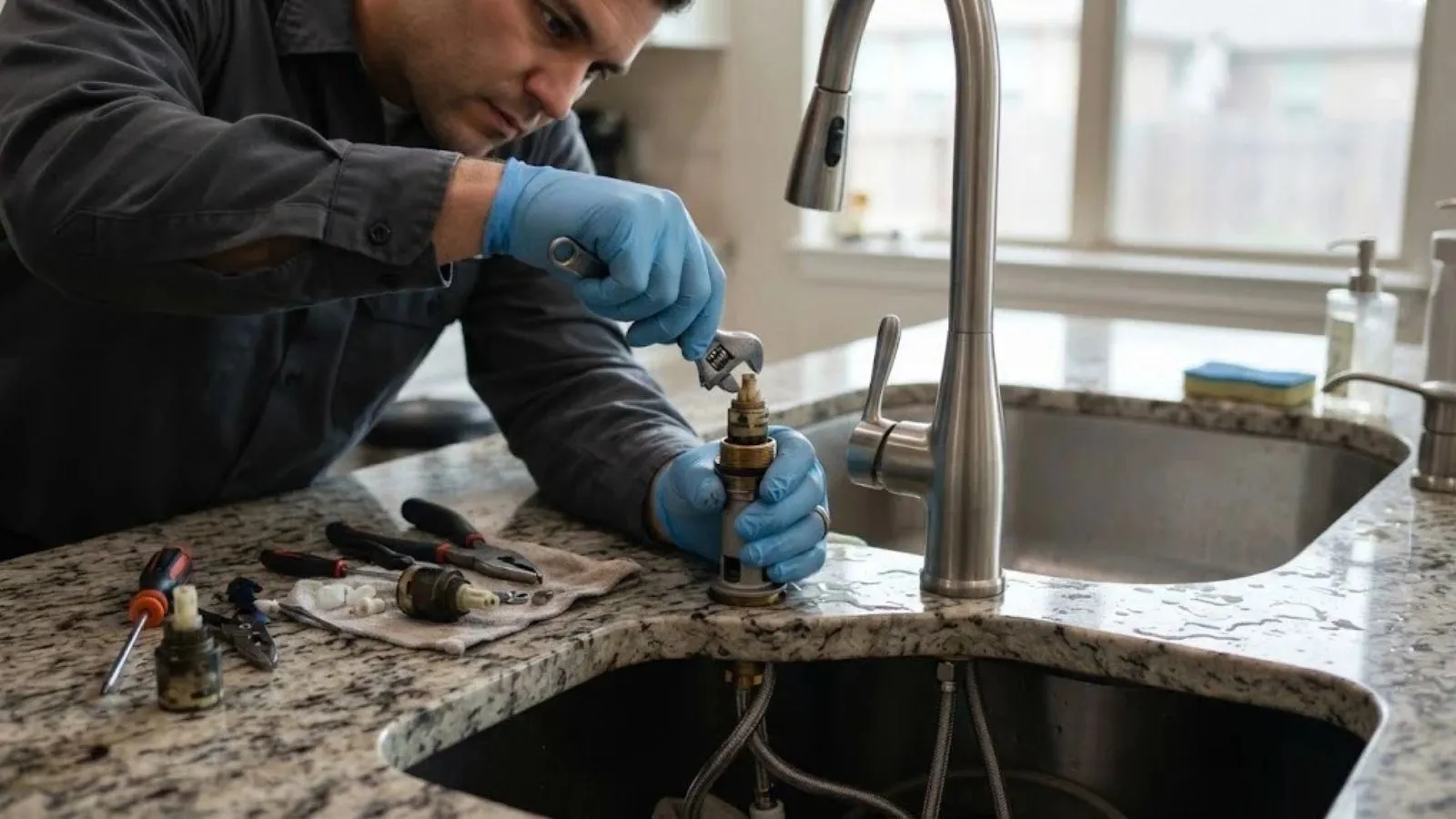
Why a faucet drips, sprays or will not stop
Almost every faucet leak comes from one of four places: the cartridge or valve seat inside, the rubber O-rings around the stem, the spout base seal, or the supply line below. Where the water appears tells you which one. A drip from the spout is a seat or cartridge. Water around the handle is a stem seal. Water under the sink is the supply side.
Faucets come in four basic designs. Compression faucets press a rubber washer on a seat, and cartridge faucets slide a plastic or brass cartridge. Ball faucets use a slotted ball with springs, and ceramic disc faucets rotate two polished discs. Each wears differently, and the repair kit for one will not fit another.
Repair is usually worth it when the body is sound and parts are available. Replacement makes more sense when the finish is pitted, the body is corroded, or the maker no longer supplies the cartridge.
Isolating a leaking fixture before anything comes apart
A careful sequence keeps a small repair from becoming a flooded cabinet.
- Find the local shutoff. Look under the sink for two small valves, one hot and one cold. Turn each clockwise until snug. No force.
- Open the faucet to bleed pressure. Leave the handle open so trapped water and air escape. Flow should stop within a few seconds.
- Identify the design. The technician removes the handle and checks whether a washer, cartridge, ball or disc sits inside, and notes scale, cracks and worn seals.
- Replace the matching parts. Seats, O-rings and cartridges are replaced as a set. Mixing old and new parts is a common reason a repair drips again.
- Test hot, cold and mixed. The tech restores pressure, runs both sides, checks the base and supply lines with a dry towel, and confirms the handle moves freely.
Broken, seized or leaking supply valves
The small stop valve under a sink, behind a toilet or at a washer box is the only thing between you and a full shutoff for that fixture. When it will not turn, drips at the stem, or snaps off in your hand, a minor repair becomes a risk. If it fails while the line is pressurized, you may have to shut off the whole house.
Older multi-turn valves seize because the stem packing hardens and scale locks the threads. Forcing one can crack the body. Newer quarter-turn valves hold up better, but a cheap plastic connector can still split.
The usual fix is a new stop valve and braided connector. Sometimes the pipe behind the wall is also corroded and needs trimming back to solid metal. A technician checks that before cutting so the new valve does not fail at its first turn. If the pipe itself has burst, our burst pipe repair service handles the line behind the wall.
Where the water shows up and what it points to
Use this table to match a leak location to the part most likely at fault.
| Where it leaks | Likely culprit | Typical repair |
|---|---|---|
| Drip from the spout | Worn seat, washer or cartridge | Replace cartridge or seat set |
| Water around the handle | Dry stem O-ring or loose retainer | New O-rings, tighten retainer |
| Pool at the spout base | Failed base seal or loose fastener | Reseal base, replace gasket |
| Wet cabinet floor | Supply line, stop valve or compression nut | New connector or stop valve |
| Showerhead drips after use | Worn shower cartridge | Replace cartridge or valve trim |
| Outdoor spigot drips | Worn washer or stem packing | Rebuild or replace the hose bib |
Leaks inside walls need a different diagnosis than a fixture drip.
Hard-water scale on Colton aerators and cartridges
The City of Colton's water quality report lists average hardness near 207 mg/L, about 12 grains per gallon, which is in the very hard band on the federal scale. That mineral load shows up in faucets as a crust on the aerator screen and in the cartridge, where it grinds against seals and makes the handle stiff or gritty.
Two practical tips follow. If the spray from your faucet has gone sideways or weak, unscrew the aerator and soak it in vinegar before assuming the faucet is failing. And if a cartridge was replaced a few years ago and is leaking again, ask the technician to check for scale on the valve body, because a rough surface chews through new seals.
Replacement faucets and supply connectors also have to meet standards set in the California Plumbing Code, which follows the Uniform Plumbing Code (UPC) as its base.
What decides the cost of a faucet or valve repair
The range is wide because a faucet job can be one rubber part or a replaced shutoff and a repaired pipe stub. These factors do most of the work in setting the price.
Valve will not shut off or a line has burst: what to do right now
If water is running and nothing at the fixture stops it, call the 24/7 line now. A running fixture, a spraying braided line or a broken stop valve is dispatched as urgent, with same-day appointments offered when available.
- Close the main water valve. It is usually near the water meter at the street or on the side of the house. Turn it clockwise until it stops.
- Open a low faucet. Relieve pressure by running a tub or outside spigot until flow stops.
- Stay out of water near outlets. If water is reaching a plug, a power strip or a garbage disposal switch, leave the area and turn off power at the panel only if it is dry and safe.
- Contain the water. Place a bucket under the leak, roll towels against the cabinet front, and lift items off the floor.
- Photograph before you clean. Pictures of the leak and the wet area help if you make an insurance claim.
Tub spouts, shower valves and the drain that will not clear
A bathtub faucet that keeps running or drips into the tub is normally the valve cartridge behind the wall plate, not the spout. A diverter that sticks and sends water to the showerhead when the tub is on is a related problem. Both are often repairable from the front without opening the wall.
A showerhead that drips after use, or a shower valve that leaks around the handle, points to a worn cartridge or seals. If the wall around the tub feels damp or the ceiling below has a stain, the leak may be in the supply pipes and needs leak detection before a fixture repair.
If a shower or tub holds water or drains slowly, hair and soap are the usual cause, and the blockage is at the trap or just beyond it. That belongs with drain cleaning, not faucet work.
When a faucet repair is not the right fix
A faucet repair will not help if the real problem is a shared supply line, a failing pressure regulator, or a leak inside the wall. If every fixture in the house drips after a water heater swap, or if pressure surges at several taps, the cause is upstream. We say so rather than replace a cartridge that will fail again.
Utility and laundry sinks, outdoor hose spigots and jetted tub fixtures are handled the same way as kitchen faucets. They each have quirks, such as frost-proof stems or a recirculating pump behind the tub, so mention the type when you call.
If you plan to replace a fixture entirely, plumbing installation covers new faucets, valves and supply lines. A home near Loma Linda or in Colton gets the same diagnosis.
Frequently asked questions
Yes. The 24/7 line is open all hours. A fixture that cannot be shut off, a spraying supply line or a broken stop valve is treated as urgent, and same-day appointments are offered when available. Close the main water valve while you wait.
If the body is sound and a cartridge or seal set exists, repair is quicker and often cheaper. Replace the faucet if the finish is pitted, the body leaks at the base, or the part is no longer made.
Mineral scale from Colton's hard water is the usual cause. It clogs the aerator screen and binds the cartridge. Soaking the aerator in vinegar often restores flow, and a stiff cartridge may need replacing.
Do not force it. Close the main valve, call us, and a technician can replace the stop valve and connector. If the valve is part of a corroded pipe stub, that gets repaired at the same time.
Often yes, from the front of the wall by replacing the cartridge or trim. If water shows in a ceiling or wall, the leak may be in the supply piping and need a different repair.
Yes. Hose bibs, utility and laundry sinks, and jetted tub fixtures are common calls. Cartridge replacement is routine across all of them.
Dry the area, close the local stop valves and watch. If the leak stops with the stops closed, it is the fixture. If it keeps going, it is the supply line or pipe behind the wall.