
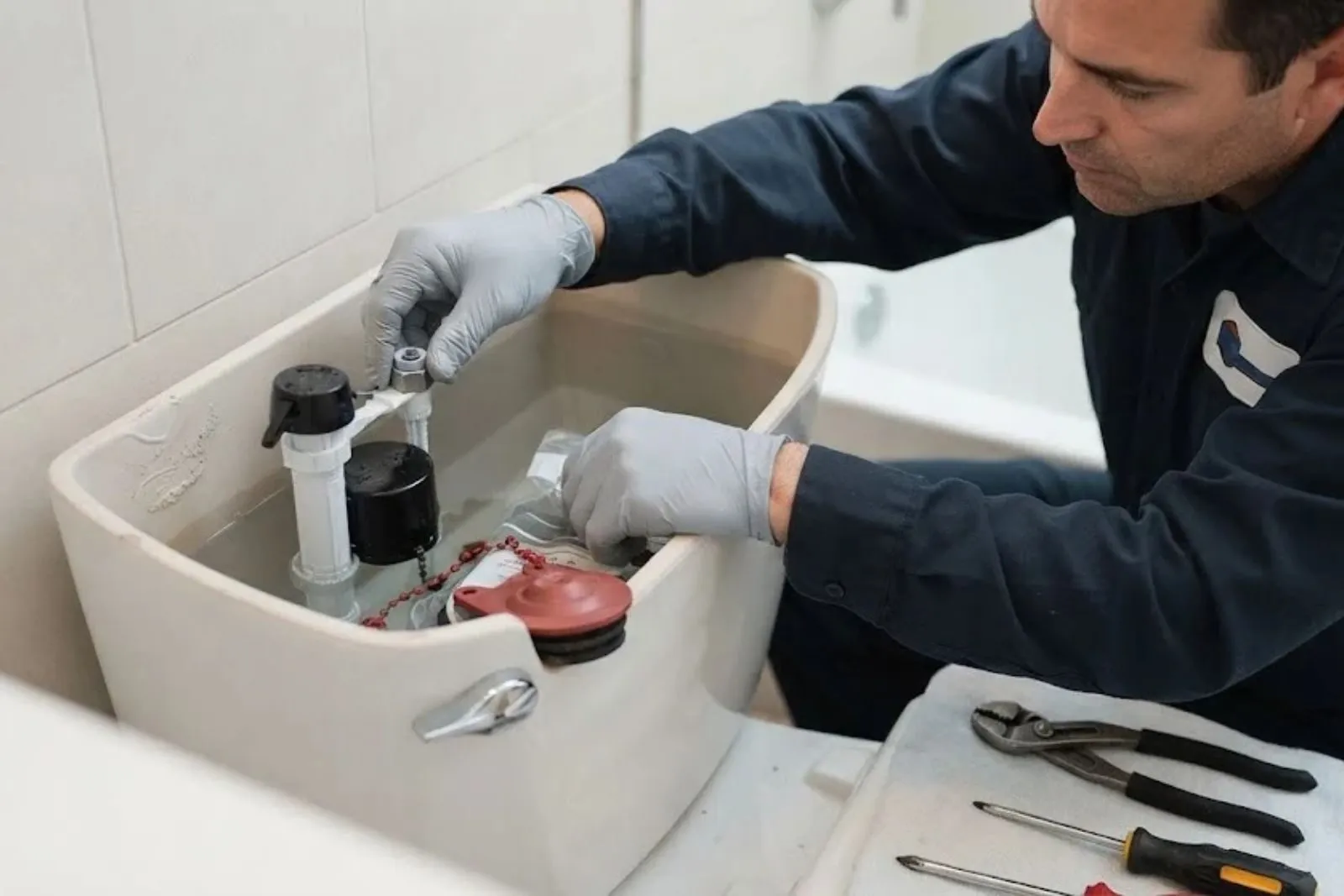
Stop the overflow, then unclog the bowl
Work in this order. Each step is safe on a standard residential toilet.
- Close the supply valve. Turn the small valve behind the toilet clockwise until it stops. This keeps the tank from refilling a bowl that is already full.
- Lift the tank lid if the bowl is near the rim. Press the rubber flapper down to stop more water from entering the bowl. Do not flush again.
- Protect the floor. Lay towels or a plastic sheet around the base. Wear rubber gloves.
- Seat the plunger and push. Make sure the rubber covers the drain hole fully. Push gently first to push out air, then pull and push firmly for about twenty seconds.
- Check the drain. If the water drops quickly, pour a bucket of water into the bowl to test it. Slow drops mean the blockage is partly cleared.
- Repeat or move to the auger. Try the plunger up to three rounds. If the bowl stays full, switch to a closet auger.
Plunger, auger or something else: matching the tool
The wrong tool can fail or hurt the porcelain.
| Tool | Use it for | Skip it when |
|---|---|---|
| Flange plunger | Most toilet clogs, because the extra rubber lip seals the bowl outlet | The toilet is full of sewage from the floor drain |
| Flat cup plunger | Sinks and tubs, since it seals on a flat surface | Used on a toilet, where it rarely seals |
| Closet auger | Clogs past the bend that a plunger will not move | The toilet is cracked or the drain is sluggish everywhere |
| Hand snake or drum machine | Not for the toilet bowl, because it can scratch porcelain | A closet auger is available |
| Plumber | Repeat clogs, multiple fixtures slow, sewage backing up | None of the above |
A closet auger has a rubber sleeve that protects the bowl.
Using a closet auger without scratching the bowl
Pull the auger's cable back into its tube, and set the curved end in the drain opening with the sleeve against the porcelain. Turn the handle clockwise while pushing gently. When you feel resistance, keep turning to hook or break the clog.
Then pull the cable back slowly, turning the handle. Flush only after you pull out the cable and the bowl has gone down. If the cable will not move, do not force it. A toy, a brush or a broken wax ring needs a different fix.
What never to do with a clogged toilet
Do not pour chemical drain openers into a toilet bowl. They sit in standing water, can crack porcelain from heat and splash out when you plunge. A plumber who opens the line later has to handle the chemicals.
Do not flush repeatedly hoping it will clear. Each flush adds tank water to a full bowl and floods the floor. Skip hot water too, because boiling water can crack the bowl.
Signs it is a main line problem, not just the toilet
A toilet that clogs once is a toilet problem. These signs point to the shared line.
- Another fixture gurgles. If the shower or tub gurgles when you flush, air is being pushed back through a blocked line.
- Water rises in the tub. A tub or shower that fills with gray water when the toilet is flushed or the washer runs is a major sign.
- More than one toilet is slow. Two toilets clogging on the same day usually share one blocked line.
- The plunger works only briefly. If the water drops and rises again an hour later, the blockage is further down the pipe.
- Sewage smell or wet cleanout. An odor in the yard or a full cleanout points to a main line backup.
Why a toilet clogs again and again
A single clog is usually too much paper or an object. Repeat clogs have a cause. A low-flow toilet with a worn flapper, a partly blocked trapway, a roots problem or an old line with a belly can all keep stopping the flush.
Try this test. Pour a bucket of water, about a gallon, into the bowl fast. A healthy toilet takes it and empties quickly. If it rises and drains slowly, the trapway or the line has a restriction.
If your toilet also rocks, leaks at the base or runs constantly, our toilet repair team can fix the wax ring, flapper and fill valve. If the main line is the issue, our drain cleaning team can clear it.
Habits that cut down on the next stoppage
Most toilet clogs come from using too much paper at once or flushing items that do not dissolve. Wipes, cotton swabs, dental floss and paper towels are the usual offenders. A small lidded wastebasket within reach removes the temptation.
Flush twice for heavy use, with a short pause so the tank refills. Teach children that toys and extra paper do not go down. If a toilet needs two flushes for ordinary use, the flush is weak and a plumber should check the rim jets and the flapper.
Colton housing details that affect toilet clogs
About 52 percent of Colton homes were built before 1980, based on the City of Colton's 2021 housing data. Older homes may have older toilets and drain lines with rougher interiors, so repeat clogs deserve a camera look instead of a third plunge. We cannot say what is in your walls, so let the tech inspect.
Roughly half of Colton's housing units are renter occupied, at 49.6 percent in the same document. If you rent, tell your landlord or property manager about a toilet that will not clear, especially if neighbors have the same issue. A shared building line is often the owner's job to repair.
Colton's water comes from City wells with total hardness averaging near 207 mg/L. Hard water can leave scale around the rim jets and at the flapper, which weakens the flush. A vinegar soak in the rim holes helps. We do not diagnose health effects of water.
When to call a plumber, and where we work
Call if the bowl keeps rising after one plunge, sewage is rising anywhere else in the house, or the clog returns within days. The 24/7 line is open for overflows. Same-day appointments when available.
If the problem reaches the main line, our sewer line cleaning service clears it with a cable or jet. We also serve San Bernardino and Grand Terrace, and the written price comes before work starts.
Frequently asked questions
Dish soap can help lubricate a soft clog. Use warm tap water, not boiling, since boiling water can crack porcelain.
Let it sit for ten minutes, then plunge.
We advise against it. Chemicals can damage the bowl and splash back on you, and they do not work well on paper or objects.
If a plumber opens the line later, standing chemicals are a hazard.
Check the flapper in the tank. A flapper that does not seal lets water run into the bowl. Our toilet repair team can replace the flapper or fill valve.
Test other fixtures. If the sink and tub also drain slowly, or gurgle when you flush, the main line is likely blocked.
That depends on the lease and the cause. Report it right away, take photos and keep receipts. If a shared line caused it, the owner usually handles repairs.
Yes, if water sits for long. Dry the area quickly and watch for soft spots or stains. Homeowners policies often cover sudden damage but exclude slow leaks, so read yours.