
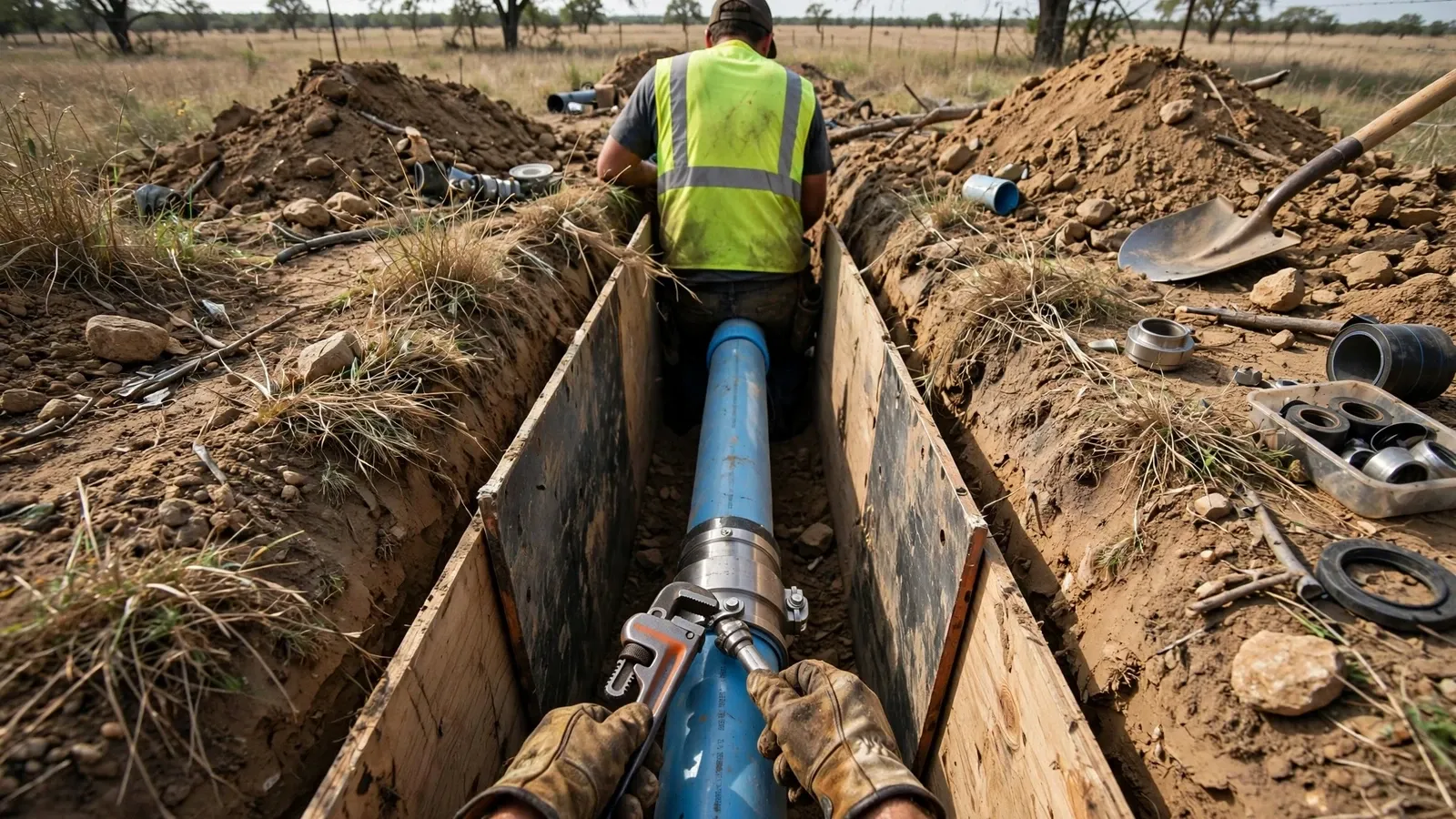
The service line: who is responsible for which stretch of pipe
As general framing, the water utility owns and maintains the meter and the main in the street. The property owner is usually responsible for the pipe from the meter to the house. Where the dividing line sits can vary, and there can be exceptions, so confirm it before you pay for a repair.
Call the City of Colton Water Utilities Department, at its office on South 10th Street, and ask where its responsibility ends and yours begins. The customer service number is on your bill, and the department has an after-hours line for emergencies. If you are not on City water, your bill will name your provider.
Signs your service line is leaking or failing
Most service line problems announce themselves before the pipe fails completely.
Soggy ground with no rain or sprinkler
A wet strip or a sunken patch between the meter and the house can mean water is escaping under pressure. Grass that is greener than the rest of the lawn is a clue too.
Meter moves with the house valve closed
If the dial keeps spinning after you shut the valve at the house, the leak is between the meter and that valve. That points to the service line.
Pressure drops or comes and goes
A leak or a clogged older pipe can reduce flow. Pressure that is weak at every fixture is a different pattern than one weak faucet.
A sudden jump in the water bill
A steady leak can use thousands of gallons without any surface sign. Compare the bill with prior months.
Dirty or discolored water after a repair or pressure change
Disturbed sediment can show after work on the line. If it persists, let a plumber check.
Low water pressure: causes beyond the service line
Weak pressure has many causes, so a plumber works through them before any digging. A pressure gauge on an outside hose bib gives a baseline reading. If the number is low at the hose bib, the problem is upstream of the fixtures. If it is normal there but weak at one tap, the cause is local to that fixture.
A pressure regulator, which many homes have near the main, can wear out and let pressure sag. A main shutoff or meter valve that is partly closed also restricts flow. Older galvanized pipe narrows from rust and mineral buildup, and clogged faucet aerators or shower heads cause weak flow at a single fixture. The utility itself can also have low pressure on its side during heavy demand or maintenance.
If the gauge shows low pressure at the hose bib and the meter is wide open, a partly blocked or leaking service line is a real suspect. If you want leak confirmation first, our leak detection service can locate the break without digging up the yard.
How a service line leak is located, dug and fixed
A careful sequence avoids hitting other utilities and keeps digging as small as possible.
- Confirm the leak. A meter test and a pressure check show whether water is escaping on the service line side.
- Call 811 before digging. California law requires a call to 811 or DigAlert at least two working days before digging so buried utilities can be marked.
- Locate the pipe and the break. Locating equipment traces the line, and listening gear narrows the leak to a few feet.
- Choose the method. A small spot repair, a trenchless pull or a full trench is picked from the findings.
- Repair, test and backfill. The new pipe is pressure tested before the trench is closed, and the surface is patched afterward.
Spot repair, trenchless or open trench: tradeoffs for a service line
The right method depends on the pipe's condition, the surface above and what lies in the way.
| Method | What it involves | Fits when | Tradeoff |
|---|---|---|---|
| Spot repair | Dig to the leak and replace a short section | One isolated failure, sound pipe elsewhere | Other weak points may fail later |
| Trenchless replacement | A new line is pulled through from small access pits | Long run under driveway, patio or landscaping | Needs a suitable path and not every site allows it |
| Open trench replacement | The old line is dug out and a new one laid | Short run, open soil, or when the path needs correction | Most surface restoration |
| Partial replacement | Only the worst stretch is replaced | Part of the line is clearly bad and part is sound | Joints between old and new need care |
Ask for the plan in writing so you can compare it between contractors.
What decides a water line repair or replacement price
Service line work is priced by how much digging, pipe and restoration the job needs, not by the symptom alone.
Pipe materials, new connections and other water line jobs
In general terms, new service lines are built from copper, plastic such as polyethylene or PEX, or other approved pipe. The best choice depends on soil, pressure, local approval and the connection points. Ask the Building Division and the water utility which materials are allowed for your job before ordering.
Water line work often comes with related jobs. A new outdoor spigot, a yard hose bib or a relocated shutoff can be added while the line is open. Larger projects, such as moving a line for a remodel or adding a new connection, fall under plumbing installation. A failed main in the street is the utility's responsibility, not yours.
Permits are set by the City, not by us. Ask the City of Colton Building Division whether your repair or replacement needs one.
Colton's water system: wells, pressure and what to ask the utility
The City of Colton's Water Utilities Department serves about 90 percent of the city proper, with over 10,500 connections and about 180 miles of pipeline, according to the City's water quality report. Its supply comes from wells that draw on groundwater basins. If your pressure changes suddenly, ask the utility whether work or a main break nearby could explain it.
The same report lists average hardness near 207 mg/L, about 12 grains per gallon. Over decades, hard water builds scale inside older steel pipe, which can narrow it and cut flow. If the house has older galvanized pipe, low pressure may come from inside the walls rather than the buried line.
Building permits go through the City's Building Division on North La Cadena Drive. We also work with homeowners in Grand Terrace, where water service may come from a different provider, so check your bill.
Water line break right now: what to do before the crew arrives
A broken water line is urgent. Call the 24/7 line, which is open at night and on weekends, and same-day appointments are available when schedules allow. Meanwhile, these steps limit the damage.
- Close the main shutoff at the house. That stops water to the home. If water still flows toward the yard, the leak is on the line before the valve.
- Do not touch the meter valve yourself unless you are sure. The meter belongs to the utility. If the leak cannot be isolated, call the City's after-hours line to have water stopped.
- Keep people and pets off soft ground. A saturated area can collapse or hide a deep wash-out near the break.
- Do not dig yourself. Digging without calling 811 first can strike gas, electric or other lines and is not allowed without notice.
- Photograph the area and meter. Record the wet area, the meter reading and the time for your records and any billing question.
Frequently asked questions
Yes. The 24/7 line takes calls for broken service lines in Colton at night and on weekends. Same-day appointments are available when schedules allow. Close the main shutoff at the house while you wait.
As general framing, the utility handles the meter and the main, and the owner handles the pipe on the house side. Where the line is drawn can vary, so confirm with the City of Colton Water Utilities Department before you authorize repairs.
Signs include a wet or sunken strip between the meter and house, a meter that moves with the house valve closed, falling pressure and a rising bill. A meter test and pressure check confirm it.
Causes include a worn pressure regulator, a partly closed valve, clogged aerators, older narrowed pipe, a service line leak or low pressure from the utility. A gauge at an outside hose bib helps narrow it down.
Trenchless replaces the pipe from small access pits and disturbs less surface. Trench replacement digs the full run. Trenchless depends on a workable path, and trench suits short or open runs.
Yes. California law requires a call to 811 or DigAlert at least two working days before digging. Never dig on your own without that notice, because buried gas and electric lines can be close to the surface.
It may be required. Ask the City of Colton Building Division what applies to your repair or replacement, and which inspection is needed.
Report it to the City of Colton Water Utilities Department. The meter and the street main belong to the utility, and they handle those repairs.