
Jammed, dead or leaking: telling a disposal problem apart
Start with sound. A steady hum with no spinning means the motor is getting power but the flywheel is stuck, usually on a bone, fruit pit or piece of silverware. A click or nothing at all points to a tripped overload, a bad switch or a dead motor. A grinding rattle suggests something hard is loose inside the chamber.
Then look at water. Wet at the top ring means the sink flange seal is failing. Wet at the side hose connections means the dishwasher inlet or drain outlet has come loose. Water beading from the bottom of the housing or around the motor shell almost always means the unit has failed internally and should be replaced.
A disposal that runs fine but leaves the sink full is a different issue. The blockage is usually in the trap and drain arm downstream of the unit, which is a job for drain cleaning, not a new motor.
Disposal leaking or jammed right now: what to do first
If water is dripping into the cabinet or the sink will not drain, call the 24/7 line. A leaking disposal is dispatched as urgent, day or night, with same-day appointments offered when available.
- Turn the switch off. Then unplug the unit from the outlet under the sink, or flip the breaker if it is hard-wired. Never reach in while it has power.
- Keep your hand out of the chamber. Use tongs or pliers to remove a visible object only after the power is off. Do not use a screwdriver to push it through.
- Stop using the sink and dishwasher. Water from either one can push more through a leaking seam and fill the cabinet.
- Catch and contain. Put a bucket or bowl under the drip, pull stored items out, and dry the cabinet floor with towels.
- Watch the electrical side. If the outlet or cord is wet, leave it unplugged and do not touch it. We do not do electrical work, but we can tell you when to bring in an electrician.
Where a disposal leaks and what it means
The location of the water gives away the failed part.
| Where water shows | Usual cause | Repair or replace |
|---|---|---|
| Top ring under the sink flange | Dried putty or loose mounting ring | Reseat the flange, often repairable |
| Side hose at the dishwasher inlet | Loose clamp or cracked rubber | Replace the hose and clamp |
| Drain outlet and trap connection | Worn gasket or loose slip nut | New gasket, realign the trap |
| Bottom of the housing or motor shell | Internal seal failure or cracked housing | Replace the unit |
| Counter air gap spits water | Blocked drain hose or clogged disposal inlet | Clear the line and check the knockout |
An active leak from the bottom of the unit is almost never worth repairing.
The reset button and hex key: safe basics and where they stop
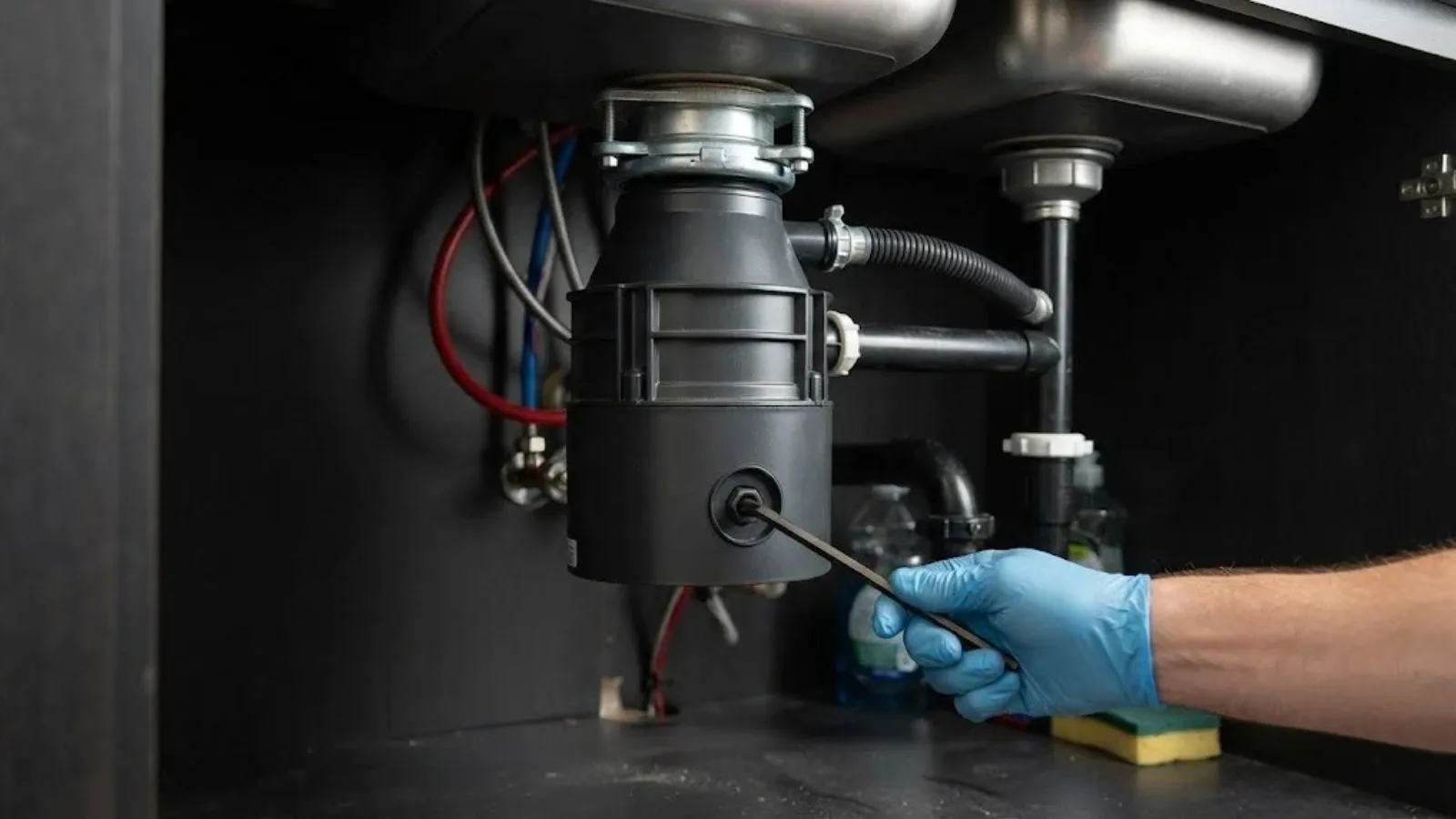
Most disposals have a small red reset button on the bottom. If the unit overheated or tripped, pressing it after it cools can bring it back. Most also have a hex socket in the center of the underside, where an Allen wrench lets you turn the flywheel back and forth by hand to free a jam.
Both tricks need the power off first, always. If the unit restarts but trips again within seconds, or the hex key spins freely with no resistance, the motor or the shaft has failed. Repeated resets on a failing motor can overheat it and ruin the wiring.
A dishwasher that drains into the disposal adds another thing to check. When a new disposal is installed, a plastic knockout plug in the dishwasher port must be removed or the dishwasher cannot drain. If a dishwasher backs up into the sink after a replacement, the plug is the first suspect.
What shapes the price of disposal repair or replacement
A reset and a replacement are very different jobs, so the price varies a lot. These are the main factors.
What should never go down the disposal
Most jams and slow drains start with food that looks harmless.
- Grease, oil and fat. They coat the drain arm, cool, and harden into a plug that keeps catching other scraps.
- Fibrous food. Celery, corn husks and artichoke leaves wrap around the shredder ring and stall it.
- Starches that swell. Rice, pasta and potato peels turn to paste and collect in the trap.
- Bones and pits. Large bones and fruit stones can jam the flywheel or chip the impellers.
- Non-food items. Bottle caps, utensils and glass wreck the grinding chamber and can cause a hard jam.
- Coffee grounds in bulk. A small amount passes through, but a pile can settle into sludge in the line.
Colton rentals and 1980s kitchens: why disposals fail here
The City of Colton's housing data shows 28.5 percent of its homes were built from 1980 to 1989, the largest share of any decade. A disposal original to a house that age has had decades of use, so a motor failure is more likely than a simple jam. Replace rather than patch if the unit is original and leaking.
About 49.6 percent of Colton homes are renter-occupied. If you rent, tell your landlord about the failure before you pay for a repair, because who handles it is usually set in your lease. If you manage rentals, the same unit call works the same way for each address.
Disposal drain connections, air gaps and trap arms are covered by the California Plumbing Code, which is based on the Uniform Plumbing Code (UPC), and a wiring fault stays with a licensed electrician under the electrical code.
Replacing a disposal and what a clean install includes
A new disposal install means removing the old mount, cleaning the sink opening, seating the new flange with putty or a gasket, and tightening the mounting ring evenly. The trap and drain arm are realigned so the outlet seals, and the dishwasher hose is clamped to the inlet. A plug-in unit goes into an existing outlet, and a leak test follows with the sink and dishwasher both running.
For a larger kitchen update, such as a new sink or a rerouted drain, our plumbing installation team can combine the work into one visit. If you find that a leaking fixture is also paired with a bad stop valve, our faucet repair service covers it.
The same diagnosis applies in Colton and in nearby Rialto. Home disposals are not built to be rebuilt, so a worn motor means a new unit.
Frequently asked questions
Yes. The 24/7 line is staffed around the clock, and a leaking or jammed disposal is dispatched as urgent. Same-day appointments are offered when available. Turn the unit off at the switch and unplug it while you wait.
The motor has power but the flywheel is stuck. With the power off, turn the hex socket under the unit back and forth with an Allen wrench, remove the cause, then press the red reset button. If it hums again, the motor may be failing.
It depends on where it leaks. A loose hose, drain gasket or top flange can usually be fixed. Water coming from the bottom or motor shell means the housing has failed and the unit should be replaced.
The disposal or trap is blocked, or the dishwasher knockout plug was never removed after a new install. Either one stops dishwasher water from leaving.
The drain line is slow or blocked beyond the air gap, so water that cannot leave the disposal comes back up through the cap. Clearing the line and disposal inlet normally stops it.
Yes, if the unit fits the sink and drain. A technician will check the mount, outlet and trap alignment before setting it. We do not do electrical work, so a missing outlet needs an electrician.
Lifespan varies with the unit and how it is used. A disposal that is leaking, jamming often or humming even after a reset is usually near the end, and replacement is the better value.