
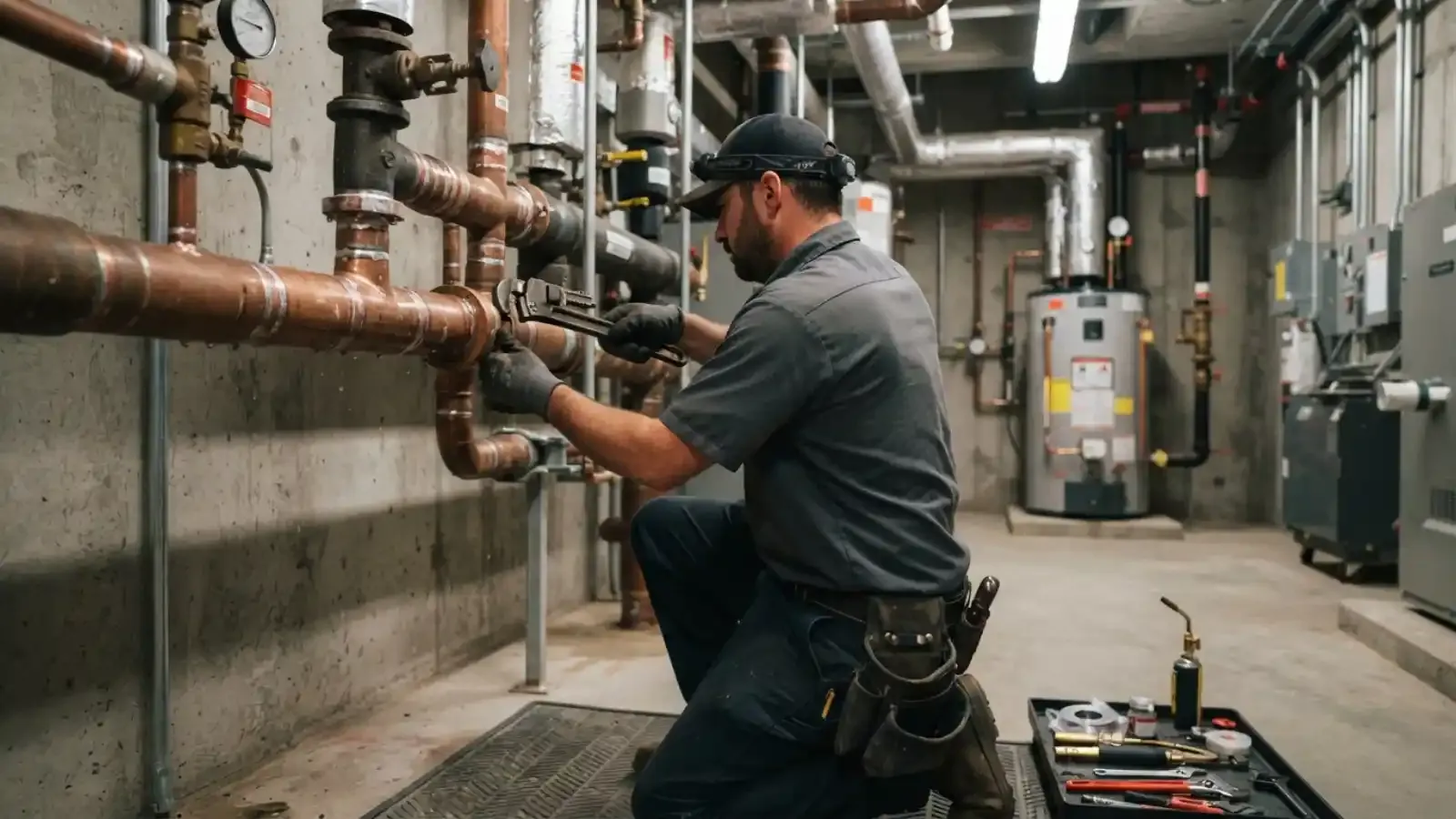
Why a commercial call is not a bigger house call
A house has one main valve and one drain line. A commercial building can have several shutoffs, shared risers, floor drains that tie into a grease interceptor, and tenants who each control a different part of the system. Finding which valve isolates which suite is often the first hour of a job.
The stakes are different too. A restroom leak in a retail space can close a store. A backed-up drain in a kitchen can stop food service. We schedule after-hours emergency dispatch for these cases, and same-day appointments are offered when available for less urgent work.
Access and approval matter as much as the repair. Many tenants do not own the pipes behind the wall, so the work may need the landlord's consent before we cut or replace anything.
The commercial calls we see most often
These are the situations that most often lead to a commercial service visit.
Leaks you cannot find
Water stains, a high meter reading or a wet slab with no visible source. See the leak investigation steps below for what a search can and cannot find.
Floor drains that overflow
Sewage or gray water rising at a floor drain usually means a blockage in the line, a failed trap seal or a full interceptor. Stop using nearby fixtures.
Grease trap or interceptor trouble
Slow kitchen drains, odors and backups point to a full or blocked grease trap. Regular cleaning prevents most emergencies.
Storm drain and roof drain clogs
Parking lot catch basins and roof drains fill with leaves, trash and silt. Ponding water after rain is the sign.
Lift station and pump failures
A sump or sewage lift pump that stops running can flood a basement or lower-level restroom within hours.
Backflow test due
Many businesses have a backflow assembly that must be tested on a schedule. This is planned work, not an emergency.
Backflow assembly testing: plan it before the notice goes overdue
A backflow prevention assembly keeps water in your building from flowing backward into the public supply. Restaurants, irrigation systems, fire sprinkler lines and some medical equipment commonly need one. The assembly has check valves and relief parts that wear, so it gets tested on a schedule.
California's cross-connection rules are part of Title 17 of the state code, and water suppliers run the program. An example ordinance from the State Water Board for small systems calls for tests at least yearly and after any installation, relocation or repair, by qualified testers. Your own water supplier sets the actual schedule and the list of testers it accepts, so ask the City of Colton water utility or whoever bills your water.
Book the test as soon as the notice arrives. A failed test means the assembly needs repair and a retest, and a supplier can act on overdue tests under its own rules. A plumber who works on commercial assemblies can repair the parts at the same visit.
Commercial leak investigation: how it goes and where it stops
A building leak search is a process of elimination, and it is honest to say it does not always end in one visit.
- Gather the clues. We ask about meter readings, wet spots, odors and when the problem began. A tenant's account is often the best starting point.
- Isolate by section. Valves are closed in turn to see which zone shows the loss. This narrows a large building down to one run of pipe.
- Test and listen. Pressure tests, acoustic listening and moisture checks locate the likely spot. Accuracy depends on access and pipe material.
- Open and repair. Once located, a small opening is made, the section is repaired and the area is left safe. Finishing work may be a separate trade.
- Confirm plumbing is the cause. Roof leaks, air conditioner condensate and exterior drainage can look like plumbing. We tell you if the source is outside our scope.
Grease traps, storm drains, floor drains and lift pumps compared
Each system has a different failure mode and a different fix.
| System | What goes wrong | What the visit involves |
|---|---|---|
| Grease trap or interceptor | Fat builds up, baffles clog, odors and backups follow | Clean the trap, clear connecting lines, check baffles |
| Storm drain and catch basin | Silt and debris block the inlet | Clear debris and flush the line |
| Floor drain | Blocked line or dry trap, causing backups or smells | Clear the line, restore the trap seal |
| Sump or lift pump | Float stuck, motor failed or discharge blocked | Test the pump, repair or replace it |
| Backflow assembly | Check valves leak or fail a test | Test, repair, retest |
Large in-ground interceptors may need a licensed hauler for full pump-out. We say so on the call.
What goes into a commercial plumbing price
Commercial work has more variables than a home repair, so the price is set after the scope is understood. These are the main drivers.
Grease trap cleaning and storm drain service in detail
Grease traps catch fats, oils and food solids before they reach the sewer. When the trap is full, the next dish rinse has nowhere to go, and the kitchen drains slow or back up. Cleaning means removing the lid, clearing the trapped material, checking the baffles and inspecting the pipes in and out. Your local sewer agency and the county environmental health office set the cleaning schedule and record keeping, so ask them what applies to your kitchen.
Storm drains are separate from the sewer. They carry rain off roofs and lots, and they clog with leaves, sediment and trash, especially before the first rain after a dry spell. Clearing them is a flush and pickup job, and a clear drain before a storm is cheaper than a flooded lot after one.
Floor drain overflow and lift pump repairs follow the same logic. We find out why the line stopped, restore flow, and tell you whether the underlying cause, such as a damaged line, needs sewer line repair. For backed-up lines with heavy buildup, hydro jetting scours the pipe wall better than a cable alone.
Colton's apartments, shops and the Valley Boulevard corridor
Colton's housing data shows 32.1 percent of homes are in multifamily buildings, and 22.5 percent are in buildings with five or more units. In those buildings a single failed riser or main drain can affect many units, and the property manager decides who gets called first. Keep your valve map and plumber's number where on-site staff can find them.
The city's commercial strip runs along Valley Boulevard, and the I-10 and I-215 interchange area brings warehouses and shops close to residential blocks. The area around Arrowhead Regional Medical Center, the city's largest employer, includes offices that cannot easily shut off water during business hours. We plan around those hours and do not imply any particular client.
Nearby customers in Rialto and Colton get the same dispatch. Our plumbers also handle leak detection when a business needs the leak found before a repair is quoted. Commercial work is held to the California Plumbing Code, which is built on the Uniform Plumbing Code (UPC), and backflow, grease and fixture-count rules are where a business feels that most.
Commercial leak or sewage backup after hours: first steps
If water is flooding a space or sewage is rising from a floor drain, call the 24/7 line now. After-hours and weekend commercial calls are dispatched as urgent, and same-day appointments are offered when available.
- Find and close the shutoff. Close the suite valve or the building main. If you do not know which is which, close the main and call the property manager.
- Stop using the fixtures. Tell staff not to flush, run sinks or use the dishwasher, because that adds water to the backup.
- Protect people and power. Keep customers and staff off wet floors and away from outlets, cords and panels.
- Save what you can. Move inventory, files and electronics off the floor, and place barriers at doors.
- Notify the right people. Tell the landlord or manager, and your insurer. In a food business, a sewage backup in the kitchen usually means pausing service, so contact your local environmental health office.
Frequently asked questions
Yes. The 24/7 line takes commercial calls at any hour. Floods, sewage backups and burst lines are dispatched as urgent, and same-day appointments are offered when available. Close the building or suite shutoff while you wait.
In an emergency, stop the water and call both. Your lease decides who pays. The landlord or property manager usually has to approve repairs on shared pipes, and we can provide a written scope for them.
Yes. Give us the addresses, valve locations and who can authorize work. Having that on file makes a night call faster, because the technician knows where to go first.
Your water supplier sets the schedule. A State Water Board example ordinance calls for testing at least once a year and after installation or repair. Ask the City of Colton water utility or your supplier for your due date and accepted testers.
Often, but not always in one visit. Success depends on access, pipe type and building size. We tell you the limits upfront and say when the cause appears to be roof, condensate or drainage instead.
Yes, including clearing the connecting lines and checking baffles. Large in-ground interceptors may require a licensed hauler for pump-out. Ask your sewer agency or local environmental health office what schedule applies.
Yes. We remove debris and flush the line. Storm drains are separate from the sewer, so ask the city where debris and wash water may go.
It depends on whether the drain is gravity fed or sends water to a lift pump. A tech checks the line first, then the pump, float and discharge. A recurring overflow is a sign of a bigger line problem.