
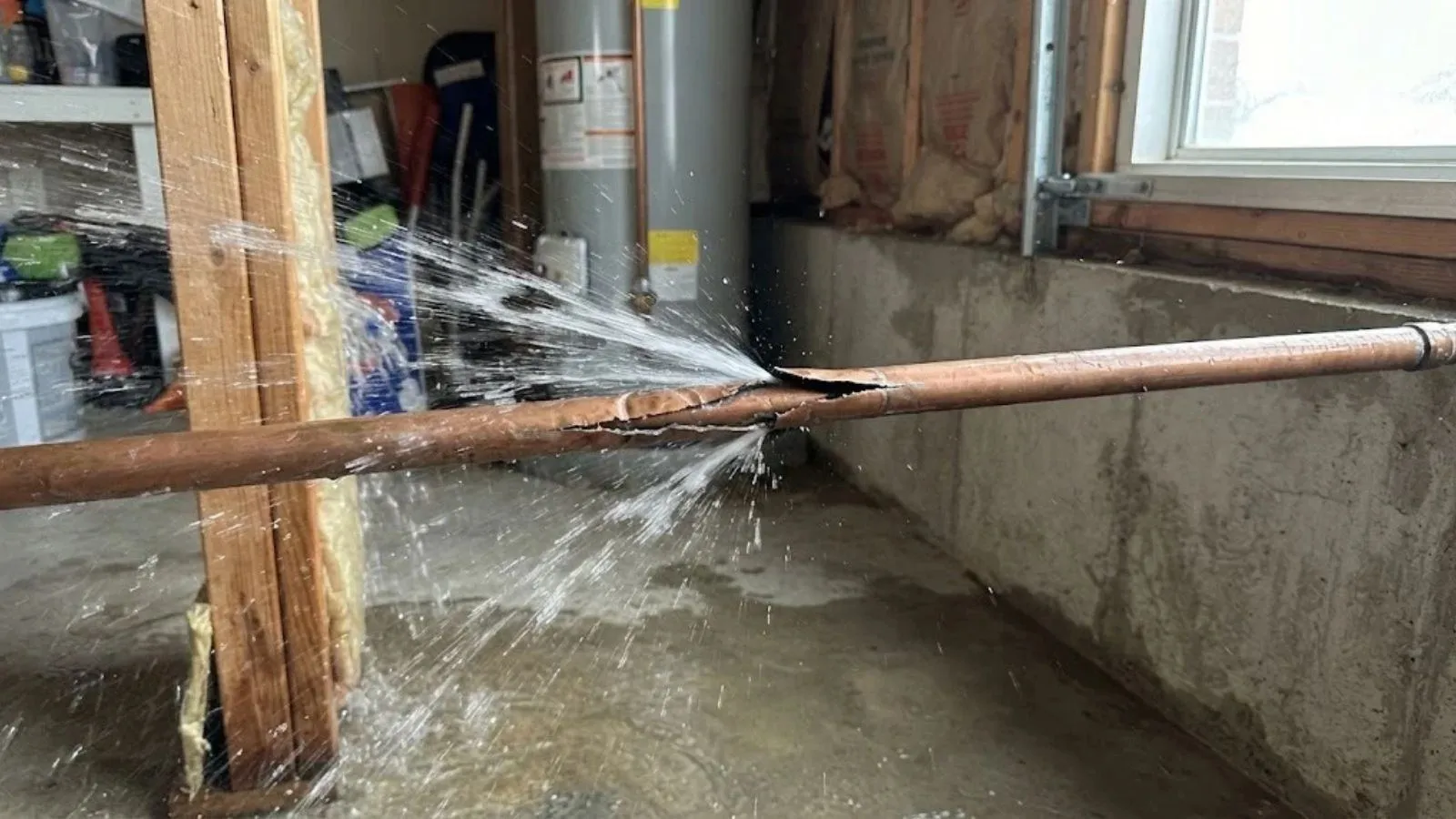
Sixty minutes, in order: stop, secure, document, call
Do these before you start mopping, because every minute with the supply open adds water.
- Close the main shutoff. Turn the valve at the house, usually near the hose bib on the street side or at the garage wall, clockwise until it stops. A lever handle turns a quarter turn so the handle sits crosswise to the pipe.
- Cut power where water is near. If water is running through a ceiling, outlet, or light fixture, switch off that breaker only when the panel is dry and you are standing on dry ground. If you cannot reach the panel without wading, stay out and call the utility or an electrician.
- Drain the system. Open the lowest faucet and the highest faucet, then flush a toilet once. This relieves pressure so the broken section stops leaking while you wait.
- Photograph and film everything. Shoot wide shots of each wet room, close shots of the break if it is visible, and any damaged belongings. Insurers ask for proof of how the loss started and what it affected.
- Contain what you can. Move rugs and electronics, put buckets under drips, and pull up pooled water with towels or a wet vac. Do not run the wet vac near wet outlets.
- Call a licensed plumber. Give the address, where the water was coming from, and whether the main is off. Ask for the written price before work starts.
Where the water shows up and what it usually means
The location of the wet spot points to the likely source, though only a plumber can confirm it.
| What you see | Likely source | First move |
|---|---|---|
| Water spraying from an exposed pipe | Split in the pipe wall or a failed joint | Main off, then open low faucets |
| Brown stain growing on a ceiling | Supply line in the attic or wall above | Main off, poke a small hole to drain the bulge into a bucket |
| Warm or damp floor, no visible water | Hot line under a slab | Main off and note which taps lost hot water |
| Wet drywall at a fixture | Failed supply connector or shutoff valve | Close the small valve under the fixture first |
| Water bubbling up in the yard | Service line between the meter and the house | Main off, then call the plumber and the water utility |
What a plumber does when they arrive at a burst pipe
The first job is confirming the water is truly off, then finding the exact break. A tech may use a moisture meter to trace the wet path, or acoustic and thermal tools when the pipe is hidden. Opening more drywall than needed costs you money, so the tracing step matters.
Next comes the repair method. A short split in accessible copper is often cut out and replaced with a new section. Where the pipe is corroded for a long stretch, replacing a larger run is usually more honest than patching one spot that will fail again beside it.
After the fix, the plumber restores pressure slowly and checks every joint they touched. Then they look at the cause, such as a failed regulator or a tired valve, so the same event does not repeat. If several runs are in poor shape, a conversation about repiping part of the house may follow.
Temporary patches that help and moves that make it worse
A rubber-and-clamp patch or a push-fit coupling can slow a leak while you wait, if the pipe around the break is still sound. Wrap the spot, tighten gently, and then keep the main closed anyway. A patch is a bridge to the real repair, not the repair.
Do not heat a pipe with a torch near wood framing, and do not hammer a crimped fitting back into shape. Do not run hot water through a line you suspect is cracked, because heat expands the metal and widens the split. If the water heater lost its supply, switch it off or set a gas unit to pilot so the tank does not heat while empty.
Skip chemical drain products and any plan to open walls yourself in a panic. Cutting a large hole in the wrong place leaves a mess and may sever a wire or another line. Let the tracing step decide where the opening goes.
Why pipes burst in a place that rarely freezes
Most people link burst pipes to winter, but a mild climate does not make plumbing immune. The common causes are corrosion that thins the pipe wall from inside or outside, joints that loosen over decades, and pressure that is higher than the system was built for.
Pressure is the one you can act on. Water hammer, the bang when a valve shuts fast, sends a shock through the line and stresses old fittings. A pressure spike at night, when nobody uses water, can push a weak spot past its limit.
Mineral scale adds a quieter problem. It builds inside pipes and on valves, so shutoffs seize and flow narrows. A narrowed pipe runs at higher local velocity, and a stuck valve means you cannot stop the water when a break happens.
The pressure regulator is the part most people never check
Many homes have a bell-shaped regulator near where the water line enters the house. It lowers the street pressure to a safer level for your fixtures. When its internal diaphragm wears out, house pressure creeps up, and weak pipes and connectors give way first.
A plumber can fit a gauge to a hose bib and read your static pressure in minutes. If the number is high, replacing the regulator is a far smaller job than repairing a burst line. Ask for the reading to be written down so you can compare it later.
Insurance claim checklist for a sudden pipe break
Homeowners policies often cover sudden and accidental water damage, and they often exclude slow leaks and wear, so the paper trail matters.
- Keep the broken part. Bag the cut section of pipe or the failed fitting. An adjuster may want to see how it failed.
- Save receipts. Keep invoices for the plumber, drying equipment, and temporary lodging if the home is unlivable.
- List damaged items. Write down each item, when you bought it, and its condition. Photos of serial numbers help for electronics.
- Call your insurer early. Ask what they need before you tear out wet material, and whether they want their own mitigation company.
- Do not wait to dry things out. Mold can start within a couple of days in a closed, wet wall, and many policies expect you to limit further damage.
Burst pipes and what is specific to Colton homes
The City of Colton's housing data shows about 52 percent of homes were built before 1980, and 28.5 percent were built from 1980 to 1989, the largest single decade. So most houses here have original valves and supply lines that have been in service a long time. Test your main shutoff once this month, before an emergency, and replace it if it will not close fully.
The city's Consumer Confidence Report lists total hardness averaging about 207 mg/L, in the very hard band on the USGS scale. Hard water leaves scale on valve seats and inside fixtures, which is why old shutoffs stick. Turn each valve gently a few times a year to keep it free.
The City of Colton Water Utilities Department serves about 90 percent of the city and posts an after-hours water line on its city pages. If water is coming up in your yard between the meter and the house, ask the utility which side of the meter the break is on, since that decides who repairs it.
We also answer calls from neighbors in Grand Terrace and Rialto, where the same older-pipe and pressure questions come up, and the first-hour steps above apply there too. Whatever the pipe is made of, the replacement has to meet the California Plumbing Code, which is based on the Uniform Plumbing Code (UPC).
Frequently asked questions
Look at the front or side of the house near the hose bib, in the garage, or beside the water heater. Many homes also have a valve at the meter box in the ground, which belongs to the utility, so ask the City of Colton Water Utilities before turning it.
Only when water is near outlets, fixtures, or the panel and you can reach the breaker while standing on dry ground. If the panel itself is wet, do not touch it. Call an electrician or the electric utility, because we do not do electrical work.
Sudden and accidental damage is often covered, while wear, corrosion, and long-term seepage are often excluded. Your policy language decides, so read it and document the damage before cleanup. Ask your insurer whether the repair of the pipe itself is covered or only the damage it caused.
A clamp or push-fit coupling can slow a leak for a short time, but it is a temporary patch. A licensed plumber should cut out the damaged section and check the surrounding pipe. A repair that hides corrosion often fails again nearby.
Yes. Corrosion, loose joints, high pressure, and water hammer all break pipes at mild temperatures. A failed pressure regulator is a frequent hidden contributor.
Shut off the main if you can reach it, then call your landlord or property manager right away, because the lease usually says who hires the plumber. Photograph your own belongings for a renters policy. In the City's housing data, nearly half of Colton homes are renter-occupied, so this comes up often.